Table of Content

Roulette Online Guide: Rules, Bets, Demo and Real Money Play

Last updated: July 2026

Roulette is one of those casino games that looks simple on the surface but rewards a closer look. A spinning wheel, a small ball, a grid of numbers. You pick where the ball will land, and the table pays you if you're right. That's the short version.

The longer version matters more. Which variation gives you better odds? What's the real difference between a roulette demo and real money play? How does a live dealer session compare to clicking "Spin" on a screen? And if you're in Australia, where does the law actually draw the line?

This guide walks through all of it. Rules, bet types, payout maths, game formats, strategy limits, and responsible play. Whether you're testing roulette for the first time or comparing live casino options before a deposit, the goal here is straightforward: give you enough detail to make informed choices, without the pressure.

Roulette Online Guide Rules, Bets, Demo

What roulette is and how the game works

Roulette is a casino table game built around a numbered spinning wheel and a small ball. The name comes from the French word meaning "little wheel." A dealer, also called a croupier, spins the wheel in one direction and releases the ball the opposite way. Players place bets on where they think the ball will land, choosing from individual numbers, groups of numbers, colours (red or black), or odd/even outcomes.

The game's appeal sits in its simplicity and variety. You can make a conservative even-money wager on red or black, or risk a straight-up bet on a single number for a 35:1 payout. That balance between low-risk and high-reward options has kept roulette at the centre of casino floors for over two centuries. And on screens, too.

Roulette originated in 18th-century France and spread through European gambling houses before crossing the Atlantic. The American version introduced a second zero pocket ("00"), which shifted the odds. Today, the three primary variations, European, American, and French, are played worldwide in both physical casinos and digital formats.

For Australian players, roulette is accessible at every licensed land-based casino in the country. Online, the situation is more complex: under the Interactive Gambling Act 2001, real-money online casino games in Australia are prohibited when offered to Australian residents. Free demo versions, however, remain widely available and are a popular way to learn the roulette game without financial risk.

What roulette is and how the

What happens in a roulette round

Whether you're sitting at a physical table or using a digital simulator, every round of playing roulette follows the same basic sequence:

  1. Choose your chip value and place your bets. Select the denomination of your chip, then position it on the roulette table layout. You can place chips on specific numbers (inside bets) or on broader categories such as red/black, odd/even, dozens, or columns (outside bets). Multiple bets per round are allowed.

  2. The wheel spins. In a live setting, the croupier announces that betting is open, then spins the wheel and releases the ball. In online RNG versions, you press the "Spin" button. The French phrase "Rien ne va plus" signals that the betting window has closed. At this point, the software locks the interface and no further wagers are accepted.

  3. The ball lands and results are determined. Once the ball settles into a numbered pocket, the winning number and colour are confirmed. In live casino environments, optical recognition technology (OCR) or sensors detect the result. In RNG-based versions, a certified random number generator determines the outcome before the animation plays.

  4. Winnings are paid and losing bets are collected. The dealer (or software) calculates payouts based on each player's bets. Winning chips are added to your balance, and the next round begins.

A typical live roulette round lasts roughly 40 to 80 seconds, depending on the number of players and the casino's pace. RNG versions can be significantly faster because there is no physical wheel or dealer interaction. Rounds may complete in under 15 seconds, and there is no time pressure on placing bets.

What happens in a roulette round

Roulette wheel, numbers and table layout

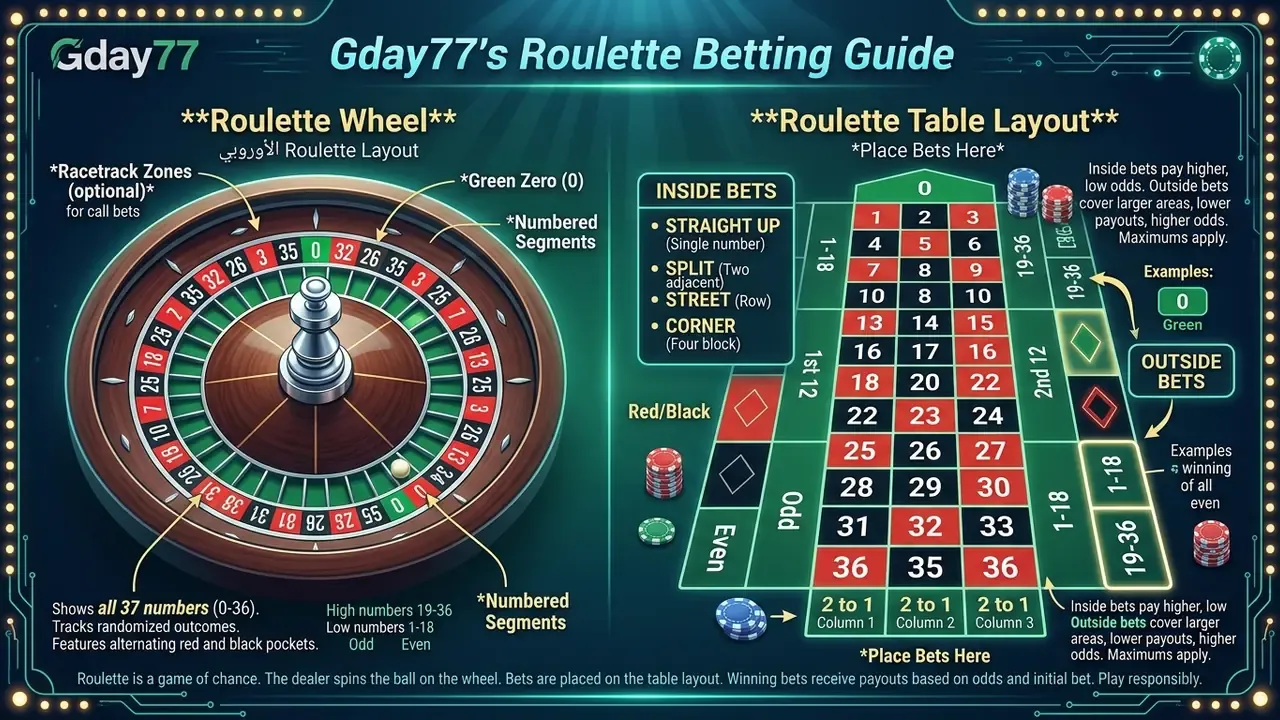
The Wheel

The roulette wheel is precision-engineered so that the ball has an equal chance of landing in any pocket. Numbers are deliberately arranged so that high and low values, as well as red and black colours, alternate as evenly as possible. Neighbours on the wheel are not neighbours on the number line. On a European wheel, for example, 32 (red) sits next to 15 (black) and 0 (green).

  • European wheel: 37 pockets. Numbers 1 to 36 plus a single green zero (0).
  • American wheel: 38 pockets. Numbers 1 to 36 plus a green zero (0) and a green double zero (00).

The zero pockets are what give the casino its mathematical edge. Every other number is coloured red or black in a fixed pattern: 18 red, 18 black, and one (or two) green.

The Table Layout (Betting Felt)

The betting felt is arranged as a rectangular grid of 12 rows and 3 columns, displaying numbers 1 to 36. The zero (and double zero in American roulette) sits at the top. Surrounding the main grid are areas for outside bets:

Roulette wheel, numbers and table layout
  • Even-money zones:Red/Black, Odd/Even, 1 to 18 (Low) / 19 to 36 (High).
  • Dozen zones:1st 12 (1 to 12), 2nd 12 (13 to 24), 3rd 12 (25 to 36).
  • Column zones:One at the bottom of each vertical column.
Gday77 heading-banner

Inside bets are placed directly on numbers or on the lines between them. Understanding this layout is key to knowing what each chip position means. It looks busier than it is, honestly. After a few rounds, the grid starts to feel intuitive.

Roulette rules every player should know

Before you try a roulette demo or sit down at a live table, it helps to understand the core rules that govern every spin. These aren't complicated, but they do shape your experience. Knowing when bets are accepted, when they lock, and how payouts work removes most of the confusion new players feel.

When bets are placed and when the spin counts

In a live roulette setting, the croupier opens the betting window by announcing "Place your bets." Players have a set period to position chips on the table. Once the dealer calls "No more bets" (or the French equivalent), the window closes. Any chips placed after that call are invalid.

In RNG roulette online, the process is simpler. You place your chips at your own pace, then click "Spin." There's no time limit before you press the button. The result is generated the moment you confirm the spin.

A valid spin requires the ball to complete a minimum number of revolutions around the wheel. If the ball bounces out or the spin is disrupted, the round is voided and replayed. In digital formats, this isn't really a concern since the software handles it automatically.

One practical note: in live dealer roulette, the betting window can feel short if you're still deciding. It's worth having your bet plan ready before the round starts, especially on busier tables.

When bets are placed and when

How winning outcomes and payouts are determined

The winning number is whichever pocket the ball comes to rest in. That number's colour (red, black, or green) also determines the outcome for colour-based bets. If the ball lands on 17 black, every bet that covers 17 or black pays out according to its specific odds.

Payouts are fixed by bet type, not by the casino's discretion. A straight-up bet always pays 35:1. A red/black bet always pays 1:1. These ratios are standard across European and American roulette, though the probability of winning each bet differs between the two because of the extra zero pocket.

Here's the thing that catches some players off guard: the zero (and double zero in American roulette) is not covered by any outside bet. If the ball lands on zero, all even-money bets lose, unless you're playing French roulette with La Partage or En Prison rules. That single green pocket is the source of the casino's house edge.

How winning outcomes and payouts are

Roulette bets and payouts explained

Understanding the bet types is where roulette starts to feel like a real game rather than just a coin flip. The table offers a wide range of wagers, from high-risk single-number picks to safer broad-coverage bets. Each one has a fixed payout and a known probability.

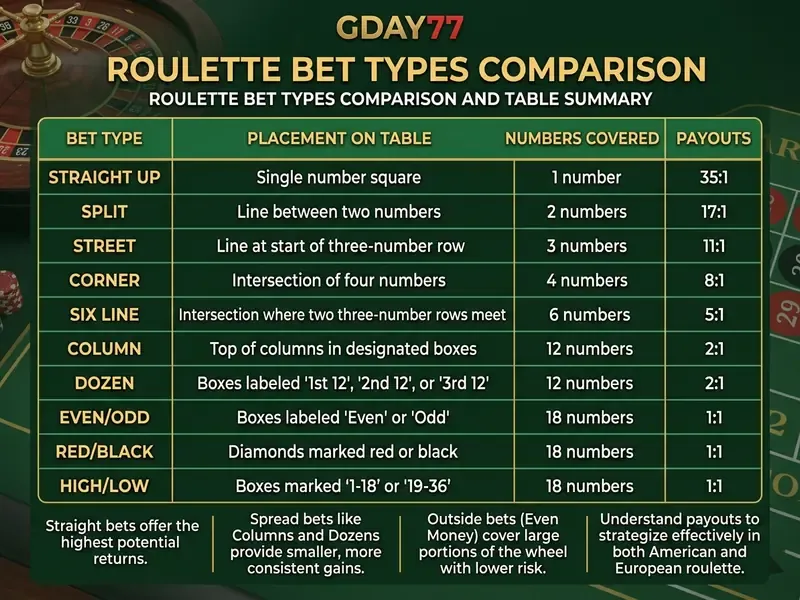
Inside bets on numbers

Inside bets are placed on specific numbers or small groups of numbers within the numbered grid. They offer higher payouts because the probability of winning is lower.

Bet TypeChip PlacementNumbers CoveredPayoutProbability (European)
Straight-UpDirectly on one number135:12.70%
SplitOn the line between two adjacent numbers217:15.41%
StreetOn the outer edge of a row of three311:18.11%
Corner (Square)On the intersection of four numbers48:110.81%
Six Line (Double Street)On the junction of two adjacent rows65:116.22%

Example: If you place a $10 straight-up bet on number 17 and the ball lands on 17, you receive $350 in winnings plus your original $10 stake. Total return: $360.

The core principle is straightforward. The fewer numbers your bet covers, the higher the risk and the higher the potential reward. Covering more numbers reduces your payout but increases how often you win. Neither approach changes the house edge, though. That stays constant regardless of bet type.

Outside bets for broader coverage

Outside bets are placed in the zones surrounding the main number grid. They cover larger groups of numbers, which means more frequent wins but smaller payouts.

Bet TypeWhat It CoversPayoutProbability (European)
Red / BlackAll 18 red or all 18 black numbers1:148.65%
Odd / EvenAll 18 odd or all 18 even numbers1:148.65%
High / Low1 to 18 (Low) or 19 to 36 (High)1:148.65%
Dozens1 to 12, 13 to 24, or 25 to 362:132.43%
ColumnsOne of three vertical columns (12 numbers)2:132.43%

Note that none of these bets covers the zero (or double zero). That single green pocket is why even-money bets don't truly pay at 50/50 odds. It's a small difference, about 1.35 percentage points on a European wheel, but it compounds over hundreds of spins.

For players who prefer longer sessions with steadier results, outside bets are the natural starting point. They won't deliver the thrill of a 35:1 hit, but they keep you in the game longer on the same bankroll.

Roulette variations: European, American and French

Not all roulette games are created equal. The three main variations share the same basic mechanics, but their differences in wheel design and special rules have a real impact on your odds. Choosing the right version is probably the single most practical decision you can make before placing a bet.

European roulette vs American roulette

European roulette is the most widely played version worldwide and the standard in Australian land-based casinos. It features a single zero (0) on a 37-pocket wheel. The house edge is 2.70% (calculated as 1 divided by 37). If you only play one version of roulette, this should be it. The single zero gives players the best base odds among the standard formats.

American roulette adds a second green pocket, the double zero (00), for a total of 38 pockets. This extra pocket increases the house edge to 5.26% (calculated as 2 divided by 38). That's nearly double the European version's edge. Despite the worse odds, American roulette remains common on offshore platforms and in US casinos.

The practical takeaway? If both European and American roulette games are available, always choose European. You're playing the same game with better maths.

European roulette vs American roulette. European
FeatureEuropeanAmerican
Zero pockets1 (0)2 (0, 00)
Total pockets3738
House edge2.70%5.26%
RTP97.30%94.74%

What makes French roulette different

French roulette uses the same single-zero wheel as European roulette but includes two special rules that benefit players on even-money bets:

  • La Partage: If the ball lands on zero, the casino returns half of every even-money bet. You lose only 50 cents on a $1 wager instead of the full dollar.
  • En Prison: If zero lands, your even-money bet is "imprisoned" for the next spin. If the next spin wins, you get your full stake back. If it loses, you forfeit the entire wager.

Both rules reduce the effective house edge on even-money bets (red/black, odd/even, high/low) to approximately 1.35%. That's the lowest standard house edge in roulette. This makes French roulette the mathematically optimal choice for players who prefer even-money wagers.

French roulette can be harder to find online, but it's worth seeking out. Some live dealer providers, including Evolution, offer French roulette tables with La Partage active. If you spot one, it's the best deal on the virtual floor.

What makes French roulette different. French
FeatureEuropeanAmericanFrench
Zero pockets1 (0)2 (0, 00)1 (0)
Total pockets373837
House edge (all bets)2.70%5.26%2.70%
House edge (even-money with La Partage)n/an/a1.35%
RTP97.30%94.74%97.30% (98.65% even-money)

Roulette online, live casino and live dealer formats

Three main formats exist for playing roulette digitally. Each has distinct characteristics, and the best fit depends on what you're actually looking for: speed, realism, or a risk-free learning environment.

Standard online roulette game

RNG roulette uses a certified random number generator to determine results. The wheel animation is purely visual. The outcome is decided by the algorithm before you see the ball land. Roulette games in this format are tested and certified by independent auditors such as eCOGRA, iTech Labs, or GLI to ensure fairness.

Pros: Fastest round speed (under 15 seconds per spin), no waiting for other players, available around the clock, play at your own pace.

Cons: No social interaction, visual-only experience, relies entirely on trust in the RNG certification.

This format suits players who want to practise decision-making or who prefer a quick, no-fuss session. It's also the format most commonly available as a roulette demo, which makes it the natural starting point for beginners.

Standard online roulette game. RNG roulette

Live dealer roulette experience

Live dealer roulette streams a real physical wheel from a studio, operated by a professional croupier. Major providers include Evolution, Playtech, and Pragmatic Play Live. The result is captured by high-definition cameras and OCR technology. Players can interact with the dealer and other players via chat.

Pros: Highest realism and atmosphere, human dealer adds trust and social interaction, ideal for players who prefer the transparency of a physical wheel.

Cons: Slower rounds (typically 40 to 80 seconds), requires stable internet connection for smooth streaming, tables may have limited seats during peak hours.

Roulette live casino sessions are particularly popular among players who want the feel of a real casino floor without leaving home. The visible wheel, the dealer's hands, the sound of the ball. It's a different experience from clicking a button and watching an animation. For some players, that difference matters a lot.

One thing worth noting: live dealer roulette tables often have higher minimum bets than RNG versions. If you're on a tight budget, check the table limits before sitting down.

Live dealer roulette experience. Live dealer
ParameterRNG OnlineLive DealerDemo (Free Play)
Round speedFastest (under 15s)Moderate (40 to 80s)Fastest (self-paced)
Realism / atmosphereLow to MediumHighLow to Medium
Learning valueMediumMediumHighest
Social interactionNoneHigh (chat + dealer)None
Financial riskReal moneyReal moneyNone

Roulette demo vs real money play

This is where the conversation shifts from theory to something more personal. A roulette demo and real money roulette use the same rules, the same odds, the same bet types. But they feel completely different. Understanding that gap before you cross it is genuinely useful.

What roulette demo is good for

Demo roulette uses the same RNG engine as real-money versions but with virtual credits instead of actual funds. It's an excellent training tool, and it's legal in Australia since free play is not classified as gambling under the IGA.

Here's what demo play does well:

  • Memorising bet types. Practice placing inside and outside bets until you can distinguish a street bet from a corner bet without thinking.
  • Reading the payout table. Make repeated bets to see how payouts correspond to coverage. This reinforces the risk-reward relationship in a way that reading a chart doesn't quite match.
  • Getting comfortable with the interface. Learn where to place chips, how to repeat or cancel bets, and how to read results. All without monetary pressure.
  • Testing pace and decision-making. Simulate a session to gauge how quickly you make decisions and whether you stay disciplined over many spins.

Important caution: Demo roulette games may use inflated virtual payouts that create unrealistic expectations about winning frequency. The Australian Institute of Family Studies has noted that "practice games offer inflated pseudo-money payout ratios that foster false beliefs about the likelihood of winning and the role of luck" (AIFS, "Is it gambling or a game?" research snapshot).

What roulette demo is good for

What changes in real money roulette

The shift from demo to money roulette introduces two fundamental changes.

Financial risk. In demo mode, losses are abstract. Virtual credits are unlimited and have no monetary value. In real-money play, every spin directly affects your bank balance. This creates the need for bankroll management: setting a fixed amount you can afford to lose before the session starts, and stopping when that limit is reached.

Table limits also become meaningful. Minimum bets define the cost of participation, and maximum bets cap the size of any single wager. These limits prevent certain progressive strategies from operating indefinitely, and they set the parameters for how quickly you can deplete your bankroll.

Psychological pressure. Real money introduces emotional stakes. Losses trigger stress, disappointment, and the temptation to "chase" losses by increasing bet sizes to recover what's been lost. This loss-chasing behaviour is one of the most well-documented pathways to problem gambling.

Variance (the natural short-term fluctuation of results) feels different when real money is involved. A streak of ten losses in demo mode is a mild annoyance. The same streak in real-money play can produce genuine distress. Understanding this psychological shift before it happens is a form of self-protection.

What changes in real money roulette

Important: Roulette real money involves financial risk. Demo play does not reflect the emotional pressure or bankroll decisions that come with real stakes. If you're considering the transition, set firm limits before your first real-money spin and treat those limits as non-negotiable.

Roulette strategy, odds and common myths

Let's be direct about this. The word "strategy" in roulette doesn't mean what it means in poker or blackjack. There's no skill-based edge to find. But that doesn't mean the topic is worthless. Understanding what a roulette strategy can and cannot do helps you avoid expensive mistakes.

What a roulette strategy can and cannot do

A roulette strategy is really a bankroll and session management approach. It can help you structure your bets, set loss limits, and decide when to walk away. What it cannot do is change the probability of any outcome. Each spin is an independent event with fixed odds. The wheel doesn't remember what happened last time.

Systems like Martingale, Fibonacci, or D'Alembert rearrange the size and timing of your bets. They do not change the probability of winning. The house edge applies to every single wager regardless of previous results.

The Martingale example: Double your bet after every loss. When you eventually win, you recover all losses plus one unit of profit. Sounds logical. The problem is twofold:

  1. Table limits. Starting with a $10 bet on red, after just seven consecutive losses your next required bet is $1,280. Many tables cap at $500 or $1,000, making continuation impossible.
  2. Bankroll exhaustion. A losing streak of 7 spins requires a cumulative outlay of $1,270. On a European wheel, the probability of 7 consecutive losses on an even-money bet is roughly 1.1%. Unlikely in any single sequence, but virtually certain over hundreds of sessions.

The Martingale doesn't change the house edge. It simply concentrates risk into rare but catastrophic losing streaks.

Practical tips that actually help:

  • Choose European or French roulette over American whenever available.
  • Set a session budget before you start and stop when it's gone.
  • Treat roulette as entertainment, not an income source. The house edge guarantees the casino will profit over the long run.
  • Avoid "guaranteed win" systems sold online. They are mathematically impossible.
What a roulette strategy can and

Common myths about beating roulette

The Gambler's Fallacy. This is the mistaken belief that past outcomes influence future spins. The classic scenario: red has appeared eight times in a row, so "black is due." In reality, the wheel has no memory. Each spin is independent. The probability of black on the next spin remains exactly 18/37 (48.65%) regardless of what happened before.

This cognitive bias is powerful because human brains are wired to detect patterns, even in genuinely random sequences. Understanding this fallacy is, well, perhaps the single most important concept for any roulette player.

"Hot" and "cold" numbers. Some platforms display recent results, showing which numbers have appeared most or least frequently. This data is meaningless for prediction. Over a small sample, random variation will always produce apparent patterns. Over millions of spins, every number converges toward the same frequency.

"The dealer can control where the ball lands." In live dealer roulette, professional croupiers spin the wheel and release the ball in a controlled manner, but the physics involved make precise targeting essentially impossible. The ball bounces off deflectors, changes speed unpredictably, and the wheel itself is spinning. Regulated casinos also audit spin patterns to detect any anomalies.

No betting system, no pattern recognition, no lucky ritual changes the maths. The house edge is a mathematical certainty derived from the independence of each spin and the fixed payout structure.

Common myths about beating roulette. The

How to choose a roulette casino or site

If you're evaluating a licensed casino offering digital roulette, or if you encounter an offshore platform, here's what matters. Not every site that offers roulette games deserves your time or trust.

Licensing and Regulation

A legitimate platform holds a licence from a recognised gambling authority. Examples include the Malta Gaming Authority (MGA), UK Gambling Commission (UKGC), or a state-level Australian regulator. The licence number should be publicly displayed on the website and verifiable on the regulator's official registry. If you can't find a licence number, that's your first red flag.

Game Fairness and RTP Transparency

Look for evidence that the roulette games are provided by reputable software developers (Evolution, Playtech, Microgaming, Pragmatic Play, among others). The platform should publish Return to Player (RTP) percentages and hold certification from independent testing labs such as eCOGRA, iTech Labs, or GLI.

Roulette Game Variety

A good roulette casino offers multiple variations: European, French, and ideally live dealer options alongside RNG versions. Demo access matters too. If a site doesn't let you try a roulette demo before depositing, that's worth questioning.

Responsible Gambling Tools

Any trustworthy platform offers deposit limits, self-exclusion options, session reminders, and links to gambling support services. The absence of these tools is a significant red flag.

Payment Methods and Withdrawal Speed

For Australian players, key considerations include support for local payment methods, clear withdrawal policies, reasonable processing times, and transparent KYC (Know Your Customer) verification procedures. If a casino takes weeks to process withdrawals or makes excuses about verification, treat that as a warning sign.

Red Flags to Watch For:

  • No visible licence or a licence from an unrecognised jurisdiction.
  • Roulette games from unknown or unverifiable software providers.
  • No responsible gambling tools or support links.
  • Unrealistic bonus offers with hidden game-weighting restrictions. Most casino bonuses heavily favour slots. Roulette typically contributes only 5 to 10% toward wagering requirements, meaning you'd need to bet 10 to 20 times more at the roulette table compared to slots to clear the same bonus. Always check the game-weighting section of the terms and conditions before accepting a bonus.
  • User complaints about withheld withdrawals or unresponsive support.
How to choose a roulette casino

Verification note: Before registering at any roulette site, cross-check the licence number on the regulator's website, search for recent player complaints on independent forums, and confirm that the roulette games listed come from providers you can verify independently. This takes five minutes and can save you real headaches.

Australia's gambling landscape is shaped primarily by the Interactive Gambling Act 2001 (IGA). Under this federal law, it is illegal for any operator to offer or advertise real-money online games of chance, including roulette and online pokies, to people physically located in Australia. The law targets operators, not individual players.

The Australian Communications and Media Authority (ACMA) enforces the IGA by ordering internet service providers to block access to illegal offshore gambling websites. Between April and June 2024, approximately fifty websites offering illegal gambling services were blocked in that quarter alone. Many of these sites offered casino table games such as roulette, blackjack, poker, and slots without an Australian licence.

Unregulated online casinos are not required to comply with anti-money laundering and counter-terrorism financing obligations, unlike regulated financial institutions (Macquarie University, "Considering Online Casino Risks: A Comparative Report"). Beyond the illegality, there are no consumer protections: no guaranteed fair play, no dispute resolution, and no responsible gambling safeguards.

Land-based casinos in Australia are regulated by state and territory governments. Each state has its own casino control authority. The NSW Independent Casino Commission, the Victorian Gambling and Casino Control Commission, and the Queensland Office of Liquor and Gaming Regulation are among the key bodies. These regulators enforce game integrity, responsible gambling measures, and anti-money laundering compliance. Licensed Australian casinos remain the primary legal venue for real-money roulette in the country.

Despite the legal prohibition on online play, some Australians do access offshore online casinos. Survey data from GambleAware NSW indicates that online casino participation remains relatively uncommon: the share of respondents reporting online casino play increased slightly from 0.5% in 2019 to 0.8% in 2024, based on a survey of 10,000 New South Wales residents (GambleAware NSW, Factsheet on Online Gambling, 2024).

Research from the Australian Institute of Family Studies indicates that about 20% of adults and adolescents who play simulated gambling games eventually move on to online commercial gambling. The Victorian Responsible Gambling Foundation and CQUniversity have noted that "the use of gambling-themed apps is associated with increased real gambling in adolescence; time spent in such games predicts time spent on real wagers in the same week" ("Gambling-like apps: not suitable for children").

Harm-reduction services

All licensed Australian casinos are required to offer responsible gambling tools, including deposit limits, loss limits, session time reminders, and self-exclusion programs.

If you answer "yes" to any of these questions, it may be time to seek support:

  • Do you spend more money on gambling than you can afford?
  • Do you gamble to escape stress or negative feelings?
  • Have you tried to win back money you've lost?
  • Has gambling caused arguments or problems in your relationships?
  • Do you feel restless or irritable when trying to reduce gambling?

Australian legal context and responsible play

FAQ about playing roulette online

Is roulette online better for free practice or live play first?

It depends on your confidence level. If you're new to roulette, starting with a roulette demo makes sense. You can learn bet types, test the interface, and understand payouts without risking anything. Once the rules feel natural and you're comfortable with the pace, a live dealer session adds realism and social interaction. There's no rush to move from one to the other. Some players stick with demo play indefinitely, and that's a perfectly valid choice.

Is online roulette legal in Australia?

Real-money online roulette offered by operators to Australian residents is prohibited under the Interactive Gambling Act 2001. The ACMA actively blocks offshore sites that breach this law. Playing roulette at licensed land-based casinos is fully legal, and free demo roulette online is not classified as gambling.

Which roulette variation gives the best odds?

French roulette with the La Partage or En Prison rule offers the lowest house edge at 1.35% on even-money bets. European roulette comes next at 2.70%. American roulette has the worst odds at 5.26% due to the double zero.

Is online roulette rigged?

At licensed and regulated casinos, roulette games use certified random number generators audited by independent labs such as eCOGRA or iTech Labs. These ensure fair and unpredictable outcomes. Unregulated offshore sites have no obligation to use certified RNG systems, and their fairness cannot be independently verified.

Can I play roulette for free?

Yes. Many websites offer free demo roulette that uses virtual credits. This is an excellent way to learn bet types, practise interface navigation, and understand payout structures without any financial risk. Demo play is legal in Australia.

What is the difference between live dealer roulette and RNG roulette?

RNG roulette is entirely software-driven. A random number generator determines the result and an animation displays it. Live dealer roulette streams a real wheel operated by a professional croupier from a studio. The result is captured by cameras and OCR technology. Live dealer games offer more realism and social interaction but have slower round times.

Can a betting system beat roulette?

No. Every betting system, including Martingale, Fibonacci, and D'Alembert, changes only the size and sequence of your bets, not the underlying probabilities. The house edge applies to every spin independently. Over the long run, no strategy can produce a positive expected return.

Can I play roulette on my mobile phone?

Free demo roulette is available on mobile browsers without any download or registration. At licensed land-based casinos in Australia, some operators offer companion apps for electronic table games. Offshore real-money apps are illegal for Australian players.

How do bonuses work for roulette?

Most casino bonuses heavily favour slots. Roulette typically contributes only 5 to 10% toward wagering requirements, meaning you'd need to bet 10 to 20 times more at the roulette table compared to slots to clear the same bonus. Always check the game-weighting section of the terms and conditions before accepting a bonus.

What should I do if I think I have a gambling problem?

Contact the National Gambling Helpline at 1800 858 858. It's free, confidential, and available 24/7. You can also reach Gambling Help Online at gamblinghelponline.org.au for live chat support. If you're in crisis, call Lifeline on 13 11 14.

Disclaimer: This article is for informational and educational purposes only. It does not constitute financial, legal, or therapeutic advice. Gambling involves risk of financial loss. If you are experiencing difficulties related to gambling, please contact the National Gambling Helpline on 1800 858 858 or visit gamblinghelponline.org.au.