Table of Content

Plinko Game Online: How to Play, Demo, Free and Real Money

Last updated: July 2026 | Reviewed by the gday77-official.live editorial team

Plinko is one of those games that looks almost too simple to hold your attention. A ball drops through rows of pegs, bounces left and right, and lands in a multiplier slot at the bottom. That is the entire concept. Yet this arcade-style casino format has become one of the most searched iGaming products among Australian players, and for good reason: the mechanics are transparent, rounds are fast, and you can adjust volatility yourself before every single drop.

This guide covers everything from the basics of how the Plinko game works to demo and free play options, real money sessions, strategy myths, casino comparisons and mobile access. Whether you are exploring Plinko for the first time or comparing providers before a deposit, the goal here is to give you clear, compliance-aware information without the usual promotional noise.

Worth noting upfront: no strategy can overcome the house edge. Plinko is a game of chance, and the RTP (commonly 97% to 99% depending on the provider) is a long-run average, not a session guarantee. Bankroll management and session limits matter more than any betting system you will find on a forum.

Provider

SPRIBE

RTP

9799%

Volatility

High

Min bet

$0.10

Max bet

$100

Max win

1,000x

Plinko Game Online How to Play

What Is the Plinko Game and How Does It Work?

If you have ever watched The Price Is Right, you already know the basic idea. A contestant drops a disc from the top of a pegged board, and it bounces unpredictably into prize slots at the bottom. The TV version was pure entertainment, not gambling. But the format's blend of simplicity and suspense made it a natural fit for online adaptation.

Modern iGaming platforms took that same visual concept and replaced TV prizes with stake-linked multipliers. Each drop becomes a wagered event. The board, the pegs, the physics: all simulated digitally by software governed by a certified random number generator (RNG) or a Provably Fair cryptographic system. The player's return depends on preset payout distributions, not a physical prop.

So why has this format taken off online? Three reasons, really. Rounds last seconds rather than minutes. The mechanics are visible (you watch the ball's path, which feels more transparent than hidden reel logic). And you control the volatility before each drop, something pokies simply do not offer.

What Is the Plinko Game and

Core Mechanics: Ball Drop, Rows and Multipliers

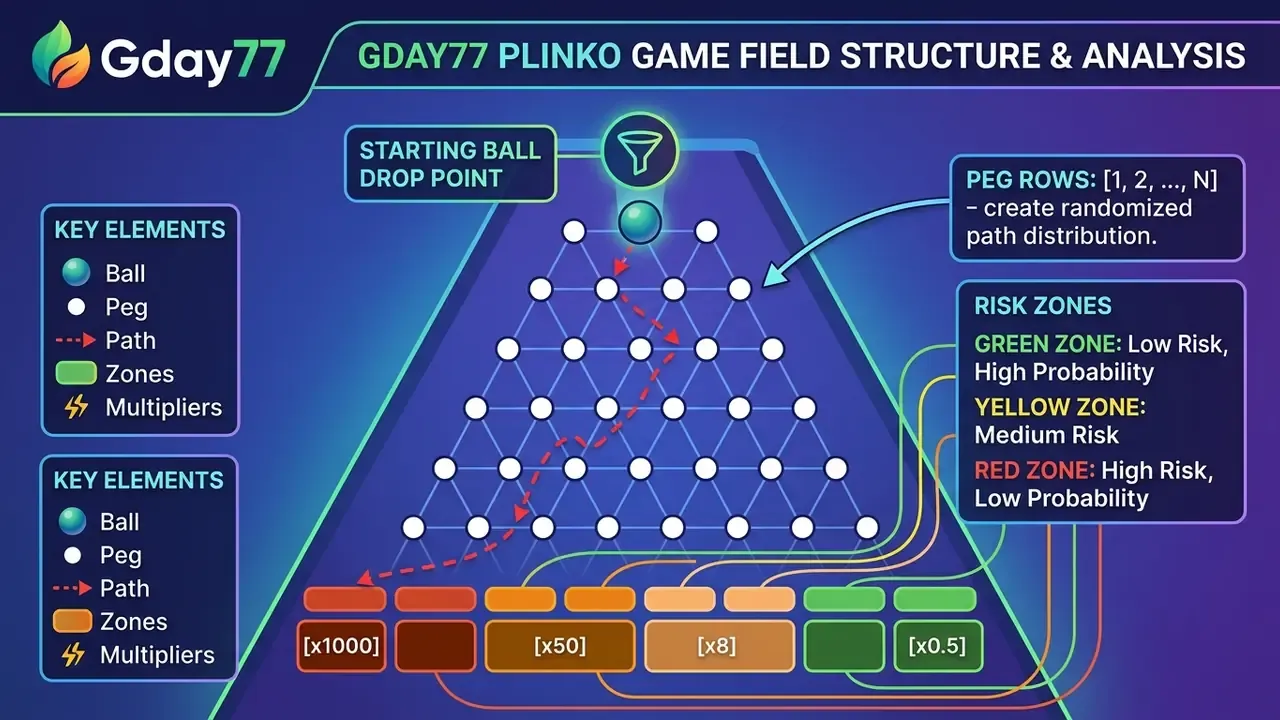
A standard online Plinko board has three key elements:

The drop point sits centred at the top, above the first row of pegs. Peg rows are arranged in a staggered, offset pattern forming a symmetrical pyramid. Each row shifts slightly relative to the one above, so the ball deflects unpredictably at every level. At the base, multiplier slots span the full width. Multipliers are typically highest at the extreme left and right edges and lowest in the centre. This is because the ball's natural tendency, governed by a binomial distribution, is to cluster toward the middle.

Here is what you can actually control:

Core Mechanics Ball Drop, Rows and
SettingOptionsEffect
Number of rows8 to 16More rows mean more deflections, wider outcome spread and higher peak multipliers
Risk levelLow, Medium, HighHigher risk compresses middle payouts (often below 1x) while inflating edge multipliers dramatically
Bet amountTypically $0.10 to $100 per drop (varies by operator)Determines the monetary value of each multiplier
Play modeManual or AutoManual drops one ball per click; Auto repeats at your chosen settings until a stop condition triggers

One thing that catches people off guard: a game can have a 99% RTP and still feel brutal in a short session. That RTP is calculated over millions of rounds. In any given sitting, you sample only a handful of bins. Because the payout table is heavily skewed, a run of central-bin results at 0.2x means losing 80% of your stake on each drop. High RTP and high volatility coexist in Plinko. This is exactly why bankroll management matters more here than in low-variance games.

How Plinko Differs from Slot and Other Casino Games

Australian players familiar with pokies will notice several structural differences:

FeatureOnline Slots (Pokies)Plinko
Outcome mechanismSpinning reels with payline/symbol matchingBall drop through pegs into multiplier bins
Player control over volatilityFixed by the game's math modelPlayer selects risk level and row count each round
Visual probability pathRandomness hidden behind reel animationProbability displayed physically as the ball deflects
Outcome per roundMultiple reel stops, scatter/bonus triggersOne ball, one bin, one multiplier
Bonus featuresFree spins, wilds, progressive jackpotsTypically none: payout is purely multiplier-based

The simplicity is the point. There are no scatter symbols to decode, no bonus wheels to trigger, no payline confusion. You set your parameters, drop the ball, and read the result. For some players, that clarity is refreshing. For others used to feature-rich pokies, it might feel stripped back. Neither reaction is wrong.

According to the Australian Communications and Media Authority (ACMA), social casinos offering free games that mimic commercial gambling products are widely available in Australia as apps and Facebook games using virtual credits. - ACMA, Report on Social Casinos and Simulated Gambling.

This regulatory observation matters because Plinko exists in both worlds: as a free social-casino game and as a real-money wagering product. The line between them carries important legal and behavioural implications covered later in this guide.

How to Play Plinko Online Step by Step

Getting started with Plinko online is genuinely straightforward. No complex rules to memorise, no strategy charts to study. But a few minutes of preparation before your first drop can save you from common mistakes, particularly around bonus terms and platform verification.

[Checklist placeholder: Step-by-step scenario for playing Plinko online. Items: open the game, choose your bet, configure settings, launch the ball, evaluate the result. Format: text-based HTML list, not embedded in an image.]

The typical journey begins with selecting a platform, either a social casino offering free play or a licensed real-money casino. Once you have an account:

  1. Choose your bet amount. Set a stake within the game's minimum and maximum limits. Common ranges are $0.10 to $100 per drop, though crypto casinos may accept fractions of a coin.

  2. Select the number of rows. More rows (up to 16) increase volatility and the size of edge multipliers.

  3. Pick a risk level. Low for steadier, smaller returns. Medium for balanced play. High for maximum multiplier potential with frequent sub-1x outcomes.

  4. Choose Manual or Auto mode. Manual lets you drop one ball per click. Auto repeats drops at your settings until a stop rule triggers (target profit, loss limit or number of rounds).

  5. Drop the ball and read the result. Watch the ball deflect through pegs. The slot it lands in displays your multiplier, and winnings are credited instantly.

Before your first drop, run through this quick checklist:

  • Verify the platform holds a valid licence (check the regulator's public register)
  • Read the bonus terms: arcade and crash games often contribute 0% to 5% toward wagering requirements, unlike pokies at 100%
  • Confirm withdrawal methods, processing times and KYC requirements
  • Check whether the game version uses Provably Fair or an audited RNG
  • Set a session budget and a stop-loss before you click "Play"

Choosing Bet Size and Game Settings

Your bet size should reflect your total session bankroll, not your enthusiasm. A common guideline is risking no more than 1% to 2% of your bankroll per drop. With a $200 session budget, that means $2 to $4 per bet. It sounds conservative, and it is. That is the point.

The risk level and row count together determine your volatility profile. Low risk on 8 rows gives you the tightest outcome range: multipliers from roughly 0.5x to 5.6x. High risk on 16 rows gives you the widest: 0.2x to 1,000x. Most balls will still land near the centre regardless of your settings, so expect frequent small losses on higher risk configurations.

One practical tip: start with Medium risk on 12 rows. It gives you a reasonable spread of outcomes without the extreme drought periods that High risk on 16 rows can produce. You can always adjust after 50 or 100 drops once you have a feel for the rhythm.

Choosing Bet Size and Game Settings

Reading Payouts Before You Play

Every Plinko version publishes its payout table in the game's rules or information panel. Read it before you play, not after. Here is a representative structure across risk levels and row counts:

RowsLow Risk (min to max)Medium Risk (min to max)High Risk (min to max)
80.5x to 5.6x0.4x to 13x0.2x to 29x
100.5x to 8.9x0.4x to 22x0.2x to 76x
120.5x to 10x0.3x to 33x0.2x to 170x
140.5x to 7.1x0.2x to 58x0.2x to 420x
160.5x to 16x0.3x to 110x0.2x to 1,000x

The pattern is consistent: as rows and risk increase, the minimum multiplier drops (meaning larger losses per drop) while the maximum multiplier climbs. At 16 rows and High Risk, the minimum is 0.2x, which is an 80% loss on every drop that lands in the centre bins. The vast majority of balls will land there. That is the trade-off for chasing the 1,000x edge slot.

Exact figures vary by provider, so always check the specific version you are playing. BGaming and Spribe publish detailed payout tables in their game interfaces. Some smaller providers are less transparent, which itself is a red flag worth noting.

The pattern is consistent as rows

Plinko Demo and Free Play: Who These Modes Are For

Most Plinko providers offer a demo or free-play version that mirrors the real-money game but uses virtual credits. The demo runs the same RNG engine and payout tables, so the mathematical behaviour should be identical. Its purpose is threefold: risk-free learning, strategy testing and interface familiarisation.

But here is something worth being honest about. Demo modes are not psychologically neutral, even though they carry no financial risk.

What You Can Learn in Plinko Demo

Demo mode is genuinely useful for understanding how the game works before you commit real funds. Specifically, you can:

Test multiplier frequency over a meaningful sample. Drop 500 or more balls at a fixed setting (say, 16 rows, High Risk) and tally how often each multiplier bucket appears. Compare your observed distribution against the game's published payout table. This exercise alone will recalibrate your expectations about how rarely those edge multipliers actually hit.

Run a fixed-session balance test. Start with a known demo balance, run exactly 100 drops at a fixed bet, and verify that your final balance matches the sum of displayed multiplier outcomes. It is a simple way to confirm the game is calculating correctly.

Compare settings side by side. Repeat 200 drops at Low, Medium and High risk on the same row count. Chart the spread of results to see how risk level shifts the payout curve. This is far more instructive than reading a table, because you experience the variance rather than just reading about it.

What You Can Learn in Plinko

Free Mode vs Real Money Mode

The mechanics are the same. Reputable providers confirm that demo and real-money modes run on the same RNG engine and payout tables. The multiplier distributions should be identical.

What changes is everything else. In free mode, there is no financial consequence. You cannot lose money, but you also cannot withdraw anything. The emotional weight of each drop is fundamentally different. Research from the Gambling Research Evidence Centre found that participants who practised in a profitable simulated environment wagered more real money than the control group, even though their session durations did not increase. - Gambling Research Evidence Centre, experimental study on practice in simulated online games.

A separate peer-reviewed study published in an international hospitality and tourism journal examined whether casino free-play credits changed subsequent wagering behaviour. The researchers found that neither player losses nor time played were significantly different on free-play visits compared with regular visits, concluding that neither a "house-money effect" nor an endowment effect was supported. The results were more consistent with prospect theory with mental accounting. - Peer-reviewed study, international hospitality and tourism journal.

These findings suggest that while demo modes are valuable learning tools, the emotional habits formed during free play, such as comfort with high-risk settings or rapid auto-play, may carry over into real-money sessions. Be aware of that transition.

A longitudinal study by the Australian Gambling Research Centre, using data from the Longitudinal Study of Australian Children (LSAC), found that roughly one in five Australian adolescents aged 16 to 17 had played simulated gambling games. Among those who had, the probability of engaging in real-money gambling by ages 18 to 19 was approximately 40 percentage points higher than among peers who had not played simulated games. - Australian Gambling Research Centre, analysis of LSAC data.

Reflecting concerns about the impact of these products on youth, the Australian Government has proposed mandatory R18+ classification for games containing simulated gambling and M classification for games with loot boxes purchasable with real money. - Australian Government, proposed guidelines for the classification of computer games.

Free Mode vs Real Money Mode

Can You Play Plinko for Real Money and What Changes?

Disclaimer: The information in this section is general in nature and does not replace professional advice. Real-money gambling involves financial risk and is available only to persons aged 18 and over. If gambling stops being enjoyable, contact a responsible-gambling support service such as Gambling Help Online (1800 858 858) or Gambler's Aid.

Short answer: yes, Plinko is widely available as a real money game. The transition from demo to deposit changes the stakes, the verification requirements and, honestly, the psychological experience of every single drop.

From Demo to Deposit: What the Transition Looks Like

The basic deposit funnel is straightforward. Fund your account, your balance is credited, choose your Plinko stake, place a bet. Typical minimum deposits sit around AU$10 to $20 for fiat casinos (card, bank transfer, e-wallet) and the equivalent for crypto casinos (Bitcoin, Ethereum, USDT). Exact thresholds are set by each operator and published on the cashier page.

Some platforms offer no-deposit bonuses or promotional credits, allowing a first Plinko round to start from bonus balance rather than a cash deposit. However, be aware that arcade and crash games like Plinko frequently contribute only 0% to 5% toward bonus wagering requirements. This is a critical detail often buried in bonus terms and conditions. If you are planning to play Plinko with bonus funds, check whether it counts toward clearing your wagering obligation at all. In many cases, it simply does not.

For licensed operators, Know Your Customer (KYC) procedures are mandatory before withdrawal. This typically involves:

  • Identity verification using a government-issued photo ID (passport, driver's licence)
  • Proof of address via a utility bill or bank statement dated within the last three months
  • Source of funds documentation, which may be required for larger withdrawals under Anti-Money Laundering (AML) regulations

Until KYC is completed, withdrawal requests can be held or rejected. Complete verification early, ideally at registration, to avoid delays when cashing out a win.

From Demo to Deposit What the

What Players Should Expect from Real Money Sessions

Here is where expectations need recalibrating. In demo mode, a string of 0.2x results feels like nothing. In real money mode, watching your $200 bankroll drop to $140 in under five minutes on High Risk settings feels very different. The maths has not changed. Your relationship to the outcome has.

Volatility is the defining feature of real money Plinko. On High Risk with 16 rows, you might see 30 or 40 consecutive drops landing in the 0.2x to 0.5x range before a single meaningful multiplier appears. That is not a malfunction. That is the binomial distribution doing exactly what it does. The RTP is still 97% to 99% over millions of rounds. Your session is not millions of rounds.

In Australia, the Interactive Gambling Act 2001 prohibits the offering of certain interactive gambling services to Australian customers without a licence. ACMA has blocked numerous casino-style sites that offered games to Australian users in breach of this Act. - ACMA, Interactive Gambling Enforcement Reports.

Players should always verify a platform's licensing status before depositing. A legitimate operator will display its licence number and regulator prominently, and the licence can be cross-checked in the regulator's public register.

What Players Should Expect from Real

Plinko Strategy: What Helps and What Is a Myth

Disclaimer: The information in this section is general in nature and does not replace professional advice. No strategy can guarantee profit in a game where the casino holds a mathematical edge.

Let's be direct about this. There is no Plinko strategy that changes the mathematical expectation of the game. The house edge is built into the payout table and applies equally to every drop. What betting systems can do is shape the variance of your session, how much your balance swings up and down, without altering the long-run cost.

[Fact check block: Common myths debunked. "There is a guaranteed winning scheme" - false. "You can consistently make money on any setting" - false. "Demo fully replicates real money by feel" - misleading. The maths is the same; the psychology is not.]

Bet Sizing and Bankroll Discipline

Players on forums and streaming communities frequently discuss three approaches:

StrategyHow It WorksRisk Profile
MartingaleDouble the bet after every loss; return to base bet after a winExtremely high: a streak of 7 to 8 losses can reach the table's max bet limit or exhaust a modest bankroll entirely
Anti-Martingale (Paroli)Increase the bet after a win; reduce after a lossModerate: captures value during winning streaks but still subject to variance
Flat betWager the same amount every round regardless of outcomeLow: preserves bankroll over longer sessions but limits upside

None of these changes the expected return. What they change is the shape of your session. Martingale, for instance, produces many small wins and occasional catastrophic losses. Flat betting produces a smoother, more predictable decline toward the house edge.

Instead of chasing a "winning system," focus on controlling what you actually can:

  • Fixed-percentage staking. Risk no more than 1% to 2% of your total session bankroll per drop. With a $200 bankroll, that means $2 to $4 per bet.
  • Session stop-loss. Decide before you start: "I will stop if my bankroll drops by 15%." For a $200 session, that means stopping at $170.
  • Session take-profit. Equally important: "I will stop and withdraw if my bankroll grows by 20%." For $200, that means banking your profit at $240. The underlying principle, defining exit points before emotions take over, is sound risk management regardless of the game.
  • Time limit. Set a 30- or 60-minute alarm. Fatigue degrades decision-making, and Plinko's fast rounds can compress a lot of betting into a short window.
  • Never chase losses. If you hit your stop-loss, close the game. Increasing bet size to "win it back" is the fastest way to blow through a bankroll.
None of these changes the expected

Why No Strategy Guarantees a Win

Three myths that keep circulating and deserve a clear response:

"The game is due for a big hit." Each drop is independent. Past results do not influence future outcomes. The ball has no memory.

"Demo and real-money modes have different RTPs." Reputable providers use the same RNG and payout tables in both modes. Minor latency differences between servers do not affect outcome distributions.

"Auto-play is luckier or unluckier than manual." The mode of triggering a drop has no influence on the RNG seed or result. Whether you click manually or let auto-play run, the mathematics is identical.

The honest truth is that Plinko's appeal lies in its entertainment value and the visible, almost hypnotic path of the ball. Treating it as an income source is a misunderstanding of how the game is designed.

Why No Strategy Guarantees a Win

Plinko Casino Options: How to Compare Versions and Offers

Multiple iGaming providers offer Plinko games with different RTPs, risk configurations and maximum multipliers. Choosing between them is not just about which one looks prettiest. The differences in RTP alone can meaningfully affect your long-run cost of play.

[Table placeholder: Comparison of Plinko versions by provider, demo/free availability, mobile support, app/download option and key features. Format: HTML table with caption, thead and tbody. Summary text below the table.]

RankGameProviderApprox. RTPMax MultiplierKey Feature
1PlinkoBGaming99%1,000xProvably Fair, 8 to 16 rows, 3 risk levels
2PlinkoSpribe99%1,000xProvably Fair, minimal UI, fast rounds
3Plinko XSmartSoft Gaming97%10,000xHigh max win, mobile-optimised
4Plinko RushBetSoft~96.3%888xPolished graphics, gamified UX
5Plinko BlitzDragon Gaming95% to 99.14%10,000xVariable RTP per configuration
6Neon PlinkoDarwin Gaming99%1,000xNeon aesthetic, smooth animation
7Golden PlinkoBelatra96.6%2,000xProgressive jackpot potential

The commonly cited "99% RTP" applies specifically to BGaming's Plinko and Spribe's version. Other providers offer games with RTPs as low as 95%. That 4% difference might not sound like much, but over hundreds of drops it compounds significantly. Always check the game rules or information panel before playing.

What Makes Different Providers and Versions Stand Out

BGaming's Plinko is probably the most widely recognised version, largely because it was one of the first to implement Provably Fair verification. You can check every single round cryptographically. Spribe's version offers a similar experience with a more minimalist interface. Both cap at 1,000x.

SmartSoft Gaming's Plinko X and Dragon Gaming's Plinko Blitz push the maximum multiplier to 10,000x, but the trade-off is a lower base RTP. Higher ceiling, steeper cost. That is the pattern across the market: providers that offer eye-catching maximum multipliers typically compensate with more aggressive payout curves that favour the house on the majority of drops.

When comparing versions, look beyond the headline multiplier. Check whether the provider publishes a detailed payout table. Check whether Provably Fair verification is available or whether the game relies on a periodic lab audit. And check whether you can adjust both rows and risk level, or whether settings are partially fixed.

What Makes Different Providers and Versions

What to Check in Casino Offers Before You Start

Before you register at a casino specifically to play Plinko, verify a few things:

  • Demo availability. Can you test the game without depositing? If a platform does not offer a demo mode, that is worth questioning.
  • Deposit conditions. What is the minimum deposit? Are there fees on your preferred payment method? How quickly are deposits credited?
  • Bonus terms. Does the welcome bonus apply to Plinko at all? Many casinos weight arcade games at 0% to 5% for wagering contribution. A $500 bonus that does not count toward Plinko play is not really a Plinko bonus.
  • Withdrawal transparency. Are processing times published? Are there withdrawal limits that might affect a large Plinko win?
  • Licensing. Is the licence number displayed and verifiable in the regulator's public register?

One thing I have noticed across dozens of casino reviews: the platforms that are most transparent about their limitations tend to be the most trustworthy overall. If a casino clearly states that Plinko contributes 5% toward wagering, that honesty is actually a positive signal.

What to Check in Casino Offers

Plinko Mobile, App and Download Options

Most modern Plinko games are built in HTML5, which means they run natively in any mobile browser (Safari, Chrome, Firefox) without a download. The interface is touch-optimised: bet adjustment, row selection and drop controls are designed for thumb-friendly interaction on smaller screens.

For most Australian players, the browser experience is seamless and requires no compromise on gameplay quality. But there are situations where a dedicated app or download makes sense.

Browser Play vs Plinko App

AspectHTML5 Mobile BrowserNative App (iOS/Android)
InstallationNone: play instantly via URLRequires download and install
UpdatesAutomatic (server-side)Requires app-store or manual update
StorageMinimal, cached in browserOccupies device storage
Push notificationsLimited (requires browser permission)Full OS-level notification support
AvailabilityAny device with a modern browserSubject to app-store policies and regional restrictions

Some operators distribute native apps or standalone APK installers for Android. Reasons players cite for downloading a separate client include push notifications for promotions, faster load times on lower-end devices, and in some regions, bypassing DNS-level blocks on gambling domains.

iOS apps that simulate gambling are subject to Apple's App Store Review Guidelines, which require age-gating and may impose an 18+ or equivalent content rating. Google Play applies similar restrictions under its real-money gambling and simulated-gambling content policies.

When Download Makes Sense

Honestly? For most players, it does not. The HTML5 browser version of Plinko loads quickly, runs smoothly and updates automatically without any action on your part. You do not need to manage app versions or worry about storage space.

A Plinko download or dedicated app becomes worth considering in a few specific scenarios. If your mobile device is older and struggles with browser-based games, a native app may perform better because it can access device hardware more directly. If you play frequently and want push notifications about deposit bonuses or new game versions, an app delivers those more reliably than browser permissions. And if your internet connection is inconsistent, some apps cache game assets locally for a smoother experience.

One caution: only download apps from official sources. The operator's website, the Apple App Store or Google Play. APK files from third-party sites carry security risks that are not worth taking for a slightly faster load time.

When Download Makes Sense. Honestly For

Responsible Gambling Resources for Australian Players

Plinko's fast rounds and auto-play feature can accelerate the pace of wagering in ways that are easy to underestimate. A single session on auto-play at one drop per second can process hundreds of bets in minutes. That speed is part of the game's appeal, but it is also a risk factor.

Australian online casinos that operate lawfully are expected to provide responsible-gambling tools, including:

  • Deposit limits to set daily, weekly or monthly caps on how much you can fund your account
  • Loss limits to cap the amount you can lose within a defined period
  • Session time limits and reality checks that remind you how long you have been playing and how much you have won or lost
  • Temporary time-outs to suspend your account for 24 hours, 7 days or longer
  • Self-exclusion to permanently or semi-permanently block yourself from an operator's platform
Responsible Gambling Resources for Australian Players

Where to Get Help

Where to Get Help

The purpose of Plinko is entertainment, not income. The house always holds a mathematical edge, and no pattern of bets can change that over time. If you find yourself playing to recover losses rather than for enjoyment, that is a signal worth paying attention to.

FAQ About Plinko

Is the Plinko Game Legit?

When players ask whether Plinko is legit, they usually mean two different things. First, is the game itself fair? And second, is the platform offering it trustworthy?

On the game side: Plinko versions from established providers like BGaming and Spribe use Provably Fair cryptographic systems that let you verify every round. Before a round begins, the casino commits to a server seed by publishing its SHA-256 hash. Your browser supplies a client seed. The outcome is computed from both seeds plus a sequential nonce. After the round, the casino reveals the server seed so you can recompute the hash and confirm it matches. Neither side can alter the result after the bet is placed.

Not all providers use Provably Fair. Some rely on conventional RNG engines audited by independent testing laboratories such as iTech Labs, eCOGRA or BMM Testlabs. One UK-licensed Plinko operator reports that its iTech Labs RNG certificate is valid until November 2026, with Shannon entropy exceeding 99.97%. - Official Plinko UK operator site, RNG and RTP compliance documentation.

On the platform side: legitimacy depends entirely on the operator. Check for a valid licence, read withdrawal terms, and look for complaint patterns before depositing. A fair game on an untrustworthy platform is still a problem.

Is Plinko Game 18+?

Real-money Plinko is restricted to players aged 18 and over. No gambling regulator issues Plinko-specific age rules, but the standard position across all jurisdictions is that real-money gambling requires adult status.

The distinction matters when it comes to demo and free-play versions. Social casino apps that use virtual credits rather than real money are technically accessible to younger users in many app stores, though the Australian Government has proposed mandatory R18+ classification for games containing simulated gambling. Until that classification is formally implemented, the age boundary between free Plinko and real-money Plinko remains somewhat blurred in practice.

If you are a parent or guardian, be aware that simulated gambling games can normalise wagering behaviour. The LSAC longitudinal data mentioned earlier in this guide found a significant correlation between adolescent simulated gambling and subsequent real-money gambling participation.

What Is the Minimum Bet for Online Plinko?

Minimum bets typically range from AU$0.01 to AU$0.10 per drop, depending on the operator and the specific Plinko version. Crypto casinos may accept even smaller amounts. Check the game's rules panel for exact limits.

Can I Use Casino Welcome Bonuses on Plinko?

In many cases, technically yes. But check the bonus terms carefully. Arcade and crash games often contribute 0% or only 5% toward wagering requirements, whereas pokies typically contribute 100%. Playing Plinko with bonus funds may not count toward clearing your wagering obligation at all, which effectively makes the bonus useless for Plinko players.

Can I Play Plinko with Cryptocurrency?

Yes. Many crypto-native casinos and some traditional operators that accept crypto deposits offer Plinko. Bitcoin, Ethereum and USDT are the most commonly supported currencies. Minimum deposits in crypto are generally lower because on-chain transfers can be credited in very small amounts.

What Is the Highest Possible Plinko Multiplier?

It depends on the provider. BGaming and Spribe cap at 1,000x. SmartSoft Gaming's Plinko X and Dragon Gaming's Plinko Blitz can reach 10,000x. Higher max multipliers typically come with lower base RTPs or more aggressive risk curves. The headline number is less important than the overall payout distribution.

How Do I Verify a Provably Fair Plinko Result?

After a round, go to the game's verification panel. Enter the revealed server seed, your client seed and the nonce. The tool will recompute the hash. If it matches the hash that was committed before your bet, the round was fair and unaltered. BGaming and Spribe both provide built-in verification tools directly in the game interface.

Does Demo Mode Use the Same RTP as Real Money Mode?

Reputable providers confirm that demo and real-money modes run on the same RNG engine and payout tables. The gameplay experience, including multiplier distributions, should be identical. If a provider's demo mode felt noticeably more generous than real-money play over a large sample, that would be a serious red flag.