
Table of Content
- What Blackjack Is and How the Game Works
- Blackjack Rules Every Player Should Know
- Australian Hole-Card Rules: OBBO, BB+1 and Beyond
- Blackjack Demo vs Real Money Blackjack
- Online Blackjack Formats: RNG, Live Dealer and Live Casino Tables
- How to Play Blackjack Online Step by Step
- Blackjack Strategy Basics for Better Decisions
- How to Evaluate a Blackjack Casino Before You Play
- FAQ About Blackjack Online
"A useful review of online blackjack starts with the legal reality for Australian players. Understanding the terms, house edge and local Interactive Gambling Act restrictions must come before any gameplay decisions." - Claire Bennett, iGaming Analyst and Contributing Editor
Last updated: July 2026
Key takeaways
- Legal reality:The Interactive Gambling Act 2001 prohibits Australian-based operators from offering real money online casino games, including blackjack, to people physically located in the country. Offshore sites remain unregulated and carry significant risk.
- House edge:Under standard rules with basic strategy, the house edge sits around 0.4 to 0.6 per cent. Switching from a 3:2 blackjack payout to 6:5 adds roughly 1.39 percentage points.
- Australian-specific rules:Unlike in the United States, Australian land-based casinos use a no-hole-card system. How the dealer handles player doubles and splits after drawing a natural 21 depends on the venue: OBO, ENHC, BB+1 or OBBO.
- Formats:RNG blackjack is fast and player-paced. Live dealer blackjack streams from studios run by providers such as Evolution and Pragmatic Play. Demo mode uses virtual credits for practice.
- Strategy matters:Following a basic strategy chart is the single most effective way to reduce the house edge. Never take insurance. Always split aces and eights.
What Blackjack Is and How the Game Works
Blackjack is a casino banking game where the player competes directly against the dealer, not against other participants at the blackjack table. The fundamental structure revolves around a fixed points system: draw cards to compile a hand value closer to 21 than the dealer's hand, without exceeding that limit. Whether you are researching online casino options or checking table variations, the underlying mathematics of card values and probabilities dictate the outcomes.
Worth noting for the Australian market: understanding this blackjack game involves more than memorising actions. It requires navigating clear legal boundaries. The Interactive Gambling Act 2001 prohibits real money casino-style games from being offered to individuals physically located within the country.
"Online casino-style games, including blackjack, are classified as prohibited interactive gambling services when offered to Australian customers." - ACMA Enforcement Report, 2024. https://www.acma.gov.au
So any review of a blackjack casino must prioritise terms, withdrawal constraints, corporate jurisdiction and safer-play functions before examining the cards themselves.
To review a blackjack game objectively, the focus stays on house edge variations, table limits, wagering conditions and the pace of the software. An informed examination limits financial exposure by clarifying exactly how the software or the live dealer governs the session.
Objective, Hand Value and the Role of the Dealer
The objective is to beat the dealer by reaching a hand value closer to 21, or by surviving when the dealer eliminates themselves by exceeding the limit. Card values form the strict foundation of the game:
- Number cards (2 to 10):carry their exact face value.
- Jacks, Queens, Kings:carry a set value of 10.
- Aces:act as either 1 or 11, depending on what benefits the hand without breaching 21.
A "soft hand" contains an ace currently valued at 11 (for example, Ace + 6 = soft 17), which gives the player flexibility to hit safely. A "hard hand" has no such flexibility and risks immediate elimination upon drawing a high card (for example, 10 + 4 = hard 14). That distinction matters more than most beginners realise.
A dealer in blackjack executes a purely mechanical function governed by fixed regulations. The dealer enforces procedural routines: taking bets, dealing alternating cards and acting only after the player has completed their hand. In standard blackjack, the dealer accepts wagers, distributes the initial cards, manages the sequence of player decisions and then plays out their own hand according to fixed instructions that leave no room for strategic choice. All house edge mathematics derive from the fact the player must act first and risk elimination before the dealer reveals and resolves their hand.
"In standard blackjack, the dealer manages bets, deals cards, oversees player actions and then resolves the dealer hand according to fixed rules - no strategic discretion is involved." - Online Blackjack in Australia: Rules, Formats, Gambling Harm and Regulatory Evidence, 2023-2026. https://www.acma.gov.au
How a Round Plays Out at a Blackjack Table
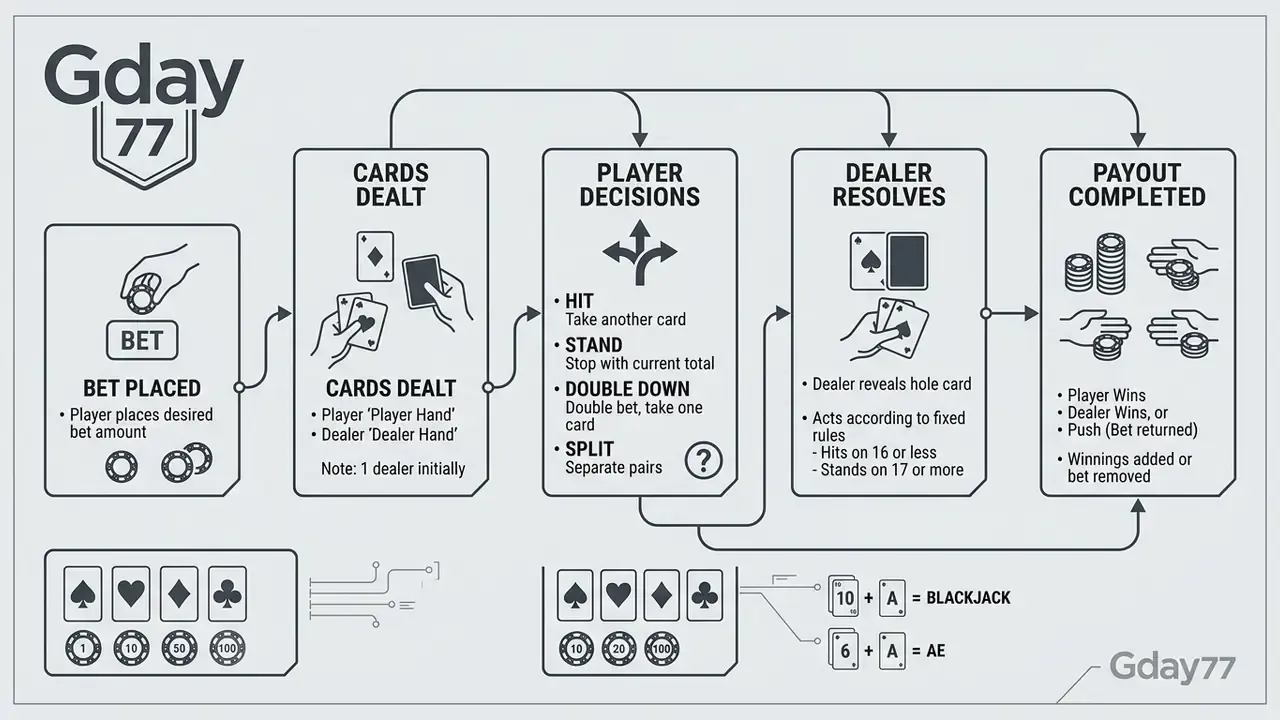
A round begins with the player placing a wager within the table limits, followed by the distribution of two initial cards to each participant. The sequence concludes after the player chooses their final actions and the dealer either stands or draws until a predetermined limit.
- Bet placed: The player selects chip value and places it in the betting circle before the countdown expires.
- Cards dealt: The player receives two face-up cards. The dealer receives one exposed card and one hidden card (in American-style games) or a single face-up card (in European and Australian no-hole-card games, covered in detail below).
- Player decisions: The player reviews their hand value against the exposed dealer card and chooses to hit, stand, double or split.
- Dealer resolves: After the player finalises, the dealer reveals any hidden card and draws until reaching at least 17 (the exact rule varies by blackjack table).
- Payout: Winning hands pay 1:1. A natural blackjack historically pays 3:2 at standard tables. Tied hands (push) result in the wager being returned.
Simple enough on paper. In practice, the pressure of that 10-second decision window changes things.
Blackjack Rules Every Player Should Know
The fundamental blackjack rules dictate how players manage their hands to influence the probability of winning against the house. These rules revolve around the primary actions available: hit, stand, double, split and surrender. Each functions under specific mathematical conditions that affect the game result. Knowing these mechanics clarifies how decisions influence risk and potential payouts dynamically.
Hit, Stand, Double and Split
- Hit:Take an extra card to increase the total. This adds a new state with higher bust risk and a new expected value based on the next-card distribution.
- Stand:Take no more cards and pass the turn to the dealer. Expected value is frozen at the current total and resolved only by the dealer's hand.
- Double:Double the initial bet in exchange for receiving exactly one additional card. This increases stake size while limiting further variance to a single draw.
- Split:Separate a pair into two autonomous hands, each requiring an extra equal bet. This converts one starting state into two independent decision trees, changing expected value through duplication of opportunity and additional wager.
- Surrender (where available):Forfeit the hand and lose only half the original bet. This converts a negative-expectation situation into a fixed partial loss.
"Doubling and splitting are among the most effective tools for reducing the house edge when applied according to basic strategy." - Online Blackjack in Australia: Rules, Formats, Gambling Harm and Regulatory Evidence, 2023-2026. https://www.acma.gov.au
Payouts, Side Bets and Rule Variations
Standard payouts return a winning hand at 1:1 and a natural blackjack often at 3:2, though variations and side bets alter these specific figures and shift the underlying house edge. When a table changes the blackjack payout from 3:2 to 6:5, the house edge increases by approximately 1.39 percentage points, severely undercutting the statistical return for players. Note: this figure is derived from standard basic-strategy probability models comparing 3:2 versus 6:5 payout schedules under otherwise identical rules.
Side bets run parallel to the primary competition but feature disproportionate risk models. Popular versions like Perfect Pairs or 21+3 depend strictly on the initial cards drawn:
- Perfect Pairs pays on the player's first two cards forming a pair (mixed, coloured or perfect), with odds set by deck count and pay schedule.
- 21+3 combines the player's two cards with the dealer's upcard to form poker-style three-card hands (flush, straight, three of a kind, straight flush, suited trips).
"The VGCCC records the continuous addition of new side bets to blackjack at Crown Melbourne, from Perfect Pairs to Pot of Gold, each with a separate payout table." - Victorian Gambling and Casino Control Commission, approved casino rule changes, 2019-2026. https://www.vgccc.vic.gov.au
Authoritative analyses by casino mathematicians consistently show that side bets carry a higher house edge than the main game. Any apparent jackpot upside is offset by a long-run player-loss expectation. In other words, they are entertainment, not strategy.
[🛡️ FACT CHECK: Common misconceptions about blackjack rules and side bets.
Purpose: Clarifies mathematical truths and demonstrates that side bets offer negative expected value.
Semantics: <aside> section formatted with definition list <dl> to structure myth versus factual reality.]
Australian Hole-Card Rules: OBBO, BB+1 and Beyond
Unlike in the United States, the dealer in Australian land-based casinos does not take a hole card. The dealer receives only one face-up card before the player acts; the second card is dealt after all player decisions are complete. This creates a critical question: what happens to a player's doubled and split bets when the dealer subsequently draws a natural blackjack?
The answer depends on the specific casino. There are four possibilities, each with a different impact on house edge:
| Rule | What happens on dealer blackjack | Effect on house edge (vs OBO baseline) |
|---|---|---|
| OBO (Original Bets Only) | Dealer takes original bet only; doubles and splits returned. Mathematically equivalent to the American peek rule. | Baseline (0.00 %) |
| ENHC (European No Hole Card) | Dealer takes the total amount bet, including doubles and splits. | -0.10 % |
| BB+1 (Busted Bets Plus One) | Dealer takes all busted bets plus one unit from each remaining hand from splits and doubles. | -0.03 % (approx.) |
| OBBO (Original and Busted Bets Only) | Dealer takes any busted bets and one unit from each un-busted hand. Player is at risk of losing additional bets from splitting, but not from doubling. | -0.02 % |
Rules consistent across Australian casinos:
- Doubling allowed on 9 to 11 only
- Double after split allowed
- Surrender not allowed
Rules that vary by venue:
- Number of decks
- Dealer hits or stands on soft 17
- Number of splits allowed
- Re-splitting aces allowed
- Hole-card rule (OBO, ENHC, BB+1 or OBBO)
Note: Crown Casino in Melbourne changed its rules to hit on soft 17, adding approximately 0.22 % to the house edge. Players should confirm current table rules directly with the venue, as conditions may have changed since the last public reporting.
Rule Variation Effects on House Edge
The following table shows the effect of various rule changes on the player's expected return. Changing two or more rules simultaneously may cause an interaction effect, so treat each figure as an approximation when combining.
| Rule variation | Effect on house edge |
|---|---|
| Dealer takes original bet only (OBO) | +0.03 % |
| Dealer takes original and busted bets (OBBO) | -0.02 % |
| Dealer takes all bets (ENHC) | -0.10 % |
| 4 decks instead of 8 | +0.07 % |
| 6 decks instead of 8 | +0.03 % |
| Dealer hits soft 17 | -0.22 % |
| Resplit 2-K to 3 hands | +0.05 % |
| Resplit 2-A to 3 hands | +0.12 % |
Understanding these variations is essential before sitting down. A seemingly minor rule change, like the dealer hitting soft 17 rather than standing, costs the player 0.22 percentage points on every hand over time. That adds up faster than most blackjack players expect.
Blackjack Demo vs Real Money Blackjack
Demo blackjack functions through non-redeemable virtual credits, whereas real money blackjack requires genuine financial commitment and risk. The mechanics remain broadly identical across these formats, yet the psychological engagement and legislative treatment fundamentally diverge. In Australia, the regulatory environment actively splits these activities into separate legal brackets based on monetary exchange.
When Demo Mode Is Useful
Demo mode serves as an isolated environment for testing decisions, verifying rule variations and learning interface limits without risking funds. It works well for rehearsing when to split, verifying the game pace and confirming how the software handles each action. Players use free options to confirm table speeds and to measure their reaction times within the decision windows generally allotted per turn in online casino formats. That window is typically around 10 to 15 seconds in RNG mode and 10 to 12 seconds in live dealer settings, though exact timings vary by provider and platform. Note: these timings are reported in operator interface documentation (e.g. Playtech and Evolution Gaming product specifications) and may differ between platforms.
However, repeated engagement with simulated environments carries distinct psychological risks entirely separate from the mathematics. This is worth pausing on.
"Simulated gambling engagement, especially in-game purchasing in social casino games, is associated with problem gambling, internet gaming disorder, psychological and emotional harm." - AIFS Review on Simulated Gambling. https://www.aifs.gov.au
Quantitative research reinforces this concern: a study of 826 Australian adolescents aged 12 to 17 found that participation in social casino games increased the likelihood of gaming disorder by a factor of 2.5 (95 % CI: 1.54 to 4.02).
"Social casino game participation was associated with a 2.5-fold increase in gambling disorder risk among adolescents." - Addictive Behaviors, study of Australian adolescents aged 12-17, N = 826, 2023. https://www.sciencedirect.com/journal/addictive-behaviors
Relying too heavily on demo formats can cultivate a distorted familiarity with variance levels. The absence of real financial consequence removes the emotional friction that shapes actual decision-making. Blackjack demo is a learning tool, not a rehearsal for how you will actually feel with real money on the line.
What Changes in Real Money Play
Playing blackjack for real money introduces immediate financial loss potential, heightened emotional reactions and strict oversight from regulatory bodies. Real stakes remove the safety net of regenerating credits, altering decision clarity drastically. Table limits become hard boundaries, and elements like bet sizing require calculated budgeting.
For Australian audiences, the legality itself shifts. Providing real cash interactive table games to Australian residents is actively shut down by federal law.
"Under the Interactive Gambling Act 2001, online casino-style games such as blackjack are classified as prohibited interactive gambling services when offered to Australian customers." - ACMA Enforcement Report, 2024. https://www.acma.gov.au
The scale of gambling-related financial loss in Australia underscores the importance of informed decision-making.
"Australians lose approximately $25 billion per year on legal forms of gambling, including casinos, EGMs and wagering." - Department of Social Services, Australia (AIHW data). https://www.dss.gov.au
That figure alone should give anyone pause before treating blackjack real money sessions casually.
⚠️ Disclaimer: This information is general in nature and does not replace professional advice. Real-money blackjack involves financial risk. In Australia, online casino-style games for real money are prohibited under federal legislation. If you experience signs of gambling harm, contact the National Gambling Helpline (1800 858 858) or visit Gambling Help Online (www.gamblinghelponline.org.au).
Online Blackjack Formats: RNG, Live Dealer and Live Casino Tables
Online platforms present blackjack via software-driven Random Number Generators (RNG) or via live dealer video streams. Each online casino format offers a distinct tempo, differing transparency methods and varying levels of social engagement. The choice directly affects the speed of rounds and the interaction tools available to blackjack players.
| Format Feature | RNG Blackjack (Automated) | Live Dealer Blackjack | Demo Blackjack |
|---|---|---|---|
| Card generation | Software algorithm (RNG) | Physical shoe and dealer | Software algorithm (RNG) |
| Round speed | Fast, controlled by player click | Dealer-paced (10-15 sec timer) | Fast, player-paced |
| Monetary risk | Real funds required | Real funds required | Virtual credits only |
| Interaction | None | Multi-way chat available | None |
| Fairness verification | Cryptographic RNG audit certificates | Camera feeds, OCR card scanning, personnel procedures | Same RNG as automated |
Standard RNG blackjack uses an algorithm to deal cards, lacking physical interaction. Live dealer blackjack features real personnel using optical character recognition (OCR) and sometimes RFID to read and log every card. Demo blackjack operates identically to RNG but strictly uses non-redeemable currency.
Standard Online Blackjack Games
Standard online blackjack games rely on an RNG algorithm to continuously shuffle and generate card combinations instantly. This format delivers a rapid game cycle free from the physical delays of a traditional room. Players retain control over the pace, pressing buttons to command the software to dispense the next card on demand.
These games use a highly functional interface, displaying clear prompts for betting limits and side options. The underlying software relies entirely on cryptographic fairness testing, conducted by independent verification facilities, to guarantee that each shuffle remains statistically independent of the prior hand dealt.
Popular RNG blackjack variants include European Blackjack, Single Deck, Multihand and Blackjack Surrender. For example, Multihand Blackjack by BGaming carries an RTP of 99.23 %, while Blackjack Lucky Sevens by Evoplay reports an RTP of 99.70 %. The exact RTP depends on the pay table and rule configuration of each title. If you are browsing blackjack sites for the first time, checking the RTP in the game info screen is a quick way to compare.

Live Dealer Blackjack Experience
Live dealer blackjack streams real-time footage of a human dealer acting from a physical table, bringing tangible elements to a digital screen. It replicates the tempo and visual proof of authentic casino operations through complex camera geometry and card-scanning systems. A built-in tracking interface acknowledges each action placed through the interactive overlay instantly.
The social component heavily mitigates the isolation of automated software. A live dealer reproduces the atmosphere of a physical casino: real cards, a video stream and chat create a social experience unavailable in RNG format. For many blackjack players, this is what makes the live casino format feel closer to the real thing.

"Live dealer blackjack reproduces the atmosphere of a physical casino - real cards, a video stream and chat provide a social experience unavailable in the RNG format." - Online Blackjack in Australia: Rules, Formats, Gambling Harm and Regulatory Evidence, 2023-2026. https://www.acma.gov.au
When choosing live blackjack tables, look for established providers with distinct offerings:
- Evolution Gaming operates studio-based live blackjack with dealer-led streaming and interactive table overlays. Their portfolio includes innovative variants such as Lightning Blackjack (random multipliers on winning hands), Infinite Blackjack (unlimited player seats on a single deal) and Free Bet Blackjack (free splits and doubles on qualifying hands).
- Pragmatic Play provides high-speed streams popular in the Australian-facing market, with selected tables showing RTPs above 99 %.
- Visionary iGaming (ViG) is known for tables where the dealer hits on soft 17 using a manually shuffled six-deck shoe, and allows doubling down after a split (except after splitting aces).
- Lucky Streak supplies live tables with stable streams and consistent dealers, as seen on platforms operating in the Australian market.
The inclusion of mechanics like Bet Behind expands participation when main seats are fully occupied, allowing a player to wager behind an active seat without occupying one themselves. It is a practical feature, though it removes your control over the hand decisions entirely.
How to Play Blackjack Online Step by Step
Starting a session involves navigating regulatory limits, confirming the software variations and managing bankroll settings via the banking interface. The process scales directly from choosing a compliant venue to executing the mechanics of placing chips and clicking operational prompts on the interface grid.
Choose a Site, a Table and Your Limits
Australian users must verify the compliance status and the exact local standing of any chosen platform before depositing. Identifying suitable blackjack tables means reviewing the minimum and maximum bets to match specific bankroll capacities securely. Legitimate operators supply readily accessible rules directly connecting table conditions with strict limits.
Selecting an environment often involves confronting offshore blackjack sites operating without basic domestic regulation.
"In January to March 2023 alone, ACMA completed 15 investigations, identified 20 breaches of the IGA and referred 56 websites for blocking by internet service providers." - ACMA, Action on Interactive Gambling, January-March 2023. https://www.acma.gov.au
Checking options involves confirming whether SSL encryption is standard and if responsible gambling functions remain accessible from the primary menu area. Limit-setting sits at the foundation of the initial assessment process. Ensure the platform supports fast local options, for example PayID for instant deposits, or cryptocurrency (Bitcoin, Ethereum) for withdrawals that can clear in under 60 minutes on some platforms.
Place Bets and Manage Your Decisions in Play
Once seated, players deposit chips directly onto the designated digital betting circle before the countdown timer expires. Managing decisions throughout the hand demands strict adherence to the planned approach and acute observation of the dealer's visible card. Interface buttons correspond directly to hitting, standing or adjusting wagers interactively.
In live applications, the dealer confirms the closed bets verbally and digitally prior to the manual draw. Participants receive an automated 10 to 15 seconds to apply their exact moves, forcing decisions to occur at a regulated rhythm. Timely management is vital since inactivity forces an automatic stand action in most network rules. That caught me off guard the first time, actually. Or rather, it catches most new players off guard.
Mobile vs desktop interfaces: On smartphones, reputable platforms keep the main action buttons (hit, stand, double, split) fixed at the bottom of the screen for thumb-friendly access. Insurance pop-ups against a dealer ace appear as overlay prompts on both mobile and desktop, though on smaller screens they may occupy a larger share of the viewport. Desktop layouts typically provide more visible chip-selection trays and a wider view of the blackjack table. If you are playing blackjack on mobile for the first time, spend a few minutes in demo mode just to learn where the buttons sit.
Blackjack Strategy Basics for Better Decisions
Operating through a concrete mathematical blackjack strategy curtails the baseline house edge by indicating the statistically correct move for every distinct card combination. It actively substitutes emotional guesswork with documented probabilities surrounding each hand. Following defined frameworks limits over-exposure and dictates risk mathematically rather than instinctively.
Why Rules and Table Conditions Matter
Table stipulations dictate elements like how a designated dealer navigates soft 17, and this immediately adjusts the core variance expected per round. An effective methodology mandates reviewing these exact house configurations before sitting down. Restrictions outlining whether doubling remains permitted post-splitting alter the capability to capitalise on mathematically advantageous moments.
When the dealer hits on soft 17, basic strategy must be adjusted to reflect the increased likelihood of the dealer improving from soft 17 to a stronger total.
"When the dealer draws on a soft 17, basic strategy must be adjusted: the probability of the dealer improving their hand increases." - Online Blackjack in Australia: Rules, Formats, Gambling Harm and Regulatory Evidence, 2023-2026. https://www.acma.gov.au
Rule configurations modulate the outcome capabilities, enforcing changes in operational techniques depending on current table bounds. Refer to the rule variation effects table in the Australian hole-card rules section above for exact percentage impacts. A small detail like "dealer hits soft 17" might seem trivial. It is not.
Basic Strategy and Common Player Mistakes
Basic strategy dictates exactly when participants should hit, stand, split or double considering the exact exposed dealer card. The primary deviations stem from instinctual errors, specifically ignoring mathematical charts or accepting disadvantageous side wagers.
Quick-reference basic strategy rules (standard multi-deck, dealer stands on soft 17):
| Player hand | Dealer shows 2-6 | Dealer shows 7-A |
|---|---|---|
| Hard 8 or less | Hit | Hit |
| Hard 9 | Double (if allowed), else Hit | Hit |
| Hard 10 | Double | Hit (if dealer shows 10 or A) |
| Hard 11 | Double | Double (Hit vs A in some rule sets) |
| Hard 12-16 | Stand (except Hit on 12 vs 2-3) | Hit |
| Hard 17+ | Stand | Stand |
| Soft 13-17 (A+2 to A+6) | Double (vs specific dealer cards), else Hit | Hit |
| Soft 18 (A+7) | Stand or Double (vs 3-6) | Stand (Hit vs 9, 10, A) |
| Soft 19-20 | Stand | Stand |
| A, A | Split | Split |
| 8, 8 | Split | Split |
| 10, 10 | Stand | Stand |
| 5, 5 | Double (treat as hard 10) | Hit (vs 10, A) |
| 4, 4 | Hit (or Split vs 5-6 if DAS) | Hit |
This table is a simplified reference. Consult a full basic strategy chart matched to the specific blackjack rules at your table (number of decks, soft 17 rule, doubling restrictions) for optimal play.
The five most costly beginner mistakes:
- Taking insurance: Insurance is mathematically a poor side bet. The probability of the dealer having blackjack when showing an ace is lower than the 2:1 payout odds imply. A basic strategy calculator recommends always declining insurance.
"A basic strategy blackjack calculator directly recommends always declining insurance, reflecting the mathematical reality of negative expectation." - Online Blackjack in Australia: Rules, Formats, Gambling Harm and Regulatory Evidence, 2023-2026. https://www.acma.gov.au
- Standing on soft 17: Soft 17 should almost always be hit (or doubled against a weak dealer card), because there is zero risk of busting and a strong chance of improvement.
- Refusing to split eights: A pair of eights totals 16, the worst hand in blackjack. Splitting converts a terrible situation into two playable hands.
- Splitting tens: A total of 20 is the second-best hand. Breaking it up to chase two hands is a long-term losing move.
- Chasing losses with progressive systems (e.g. Martingale): Doubling the bet after every loss does not change the house edge. It merely amplifies variance and accelerates bankroll depletion. The maths does not care about your streak.
How to Evaluate a Blackjack Casino Before You Play
Reviewing a platform effectively means prioritising current licensing compliance, authenticating withdrawal restrictions and inspecting responsible features instead of chasing promotional banners. Scrutiny targets operational credibility to define whether the operator maintains adequate data encryption alongside verified technical testing. Finding a reliable blackjack site requires thorough verification beyond basic aesthetic displays.
"One in five respondents (21 %) to the NSW Gambling Survey 2024 reported experiencing harm from gambling; casino games and online casinos were among the top sources of that harm." - NSW Gambling Survey 2024. https://www.gambleaware.nsw.gov.au
Casino evaluation checklist
- ☐ Check regulatory licence and specific jurisdiction restrictions
- ☐ Read withdrawal terms and identify absolute maximum payout limits
- ☐ Confirm wagering multiples attached to any bonus offer
- ☐ Locate the responsible gambling features inside the account dashboard
- ☐ Verify that standard table-testing certificates remain currently active
- ☐ Check for SSL/TLS encryption (HTTPS in the browser bar)
- ☐ Confirm live-lobby availability and named studio providers
- ☐ Verify the diversity of software providers (not only proprietary engines)
- ☐ Test mobile responsiveness: lobby navigation, chip selection and cashier on a phone
⚠️ Disclaimer: This information is general in nature and does not replace professional advice. Verify the current legal status of any platform in accordance with the legislation of your jurisdiction before depositing funds. Real money blackjack involves financial risk, and the availability of any offer or gambling option depends on the rules of the specific site and region.
Game Variety, Table Options and Live Dealer Access
A credible operator maintains a comprehensive lobby showcasing explicit access to automated configurations and reliable live streams from trusted studios. Game variety guarantees players encounter testing standardisation through major global developers rather than obscure proprietary engines. It ensures that standard configurations, free bet iterations and varying card numbers display exact RTP (Return to Player) indexes.
For example, platforms in the Australian-facing market may offer 35 or more blackjack games spanning European Blackjack, Single Deck, Multihand and Blackjack Surrender, alongside 20 to 100+ live tables from studios such as Evolution, Pragmatic Play and Lucky Streak. The exact numbers and available titles vary by operator and should be confirmed directly.
Live dealer availability usually confirms that the platform connects with high-capacity infrastructure demanding substantial corporate overhead. Reputable blackjack casinos categorise options visibly, separating heavily modified side-bet interfaces from traditional configurations. If you cannot find a clear game lobby with named providers, that itself is a red flag.
"Queensland's Casino Control and Other Legislation Amendment Bill 2023 introduced mandatory carded play and a pre-commitment system for casino table games, including blackjack." - Casino Control and Other Legislation Amendment Bill 2023, Queensland Parliament. https://www.parliament.qld.gov.au
Bonuses, Payments and Mobile Experience
Genuine commercial bonuses use transparent wagering multipliers that clearly specify restrictions. Operators frequently restrict table contributions toward these wagering volumes, often limiting standard blackjack completions to merely 5 or 10 per cent of the wagering requirement.
Why this matters, a practical example: If you accept a $100 bonus with a 30x wagering requirement, your total wagering obligation is $3,000. On slots (typically 100 % contribution), you would need to wager $3,000. On blackjack at 10 % contribution, the effective requirement becomes $30,000 in blackjack wagers, ten times the workload. At 5 % contribution, it becomes $60,000. This makes most bonus offers impractical for blackjack-only sessions. Read the terms before you commit. Seriously.
Checking withdrawal capacities directly confirms practical capability, isolating venues holding funds unjustifiably. Ensure the casino supports payment methods relevant to the Australian market:
- PayID:Instant deposits via bank transfer.
- Cryptocurrency (Bitcoin, Ethereum, Litecoin):Some platforms process crypto withdrawals in under 60 minutes.
- Credit/debit cards (Visa, Mastercard):Widely accepted but may face bank-side blocking for gambling transactions.
- E-wallets (MiFinity, eZeeWallet):Fast transactions with low fees.
Note: bonus terms, payment methods and processing times change frequently. Always verify current conditions directly with the operator.
Functionality transitions across devices demand that any viable platform runs responsively on mobile without sacrificing table-tracking accuracy. Dependable technical structures permit users to manipulate chip limits smoothly on smaller screens. If the mobile cashier feels clunky during a test deposit, the live table experience is unlikely to be better.
FAQ About Blackjack Online
Is it legal to play online blackjack for real money in Australia?
Under the Interactive Gambling Act 2001, it is prohibited for operators to offer real money online casino-style games, including blackjack, to individuals physically located in Australia. The law targets the provider, not the player, but accessing offshore unregulated sites carries significant risks including account blockages, fund seizures and lack of legal recourse.
How does the software ensure fairness in online blackjack?
Modern certified programs use sophisticated Random Number Generators audited by independent verification testing facilities (such as eCOGRA, iTech Labs or GLI) to enforce complete structural randomness. Each shuffle is statistically independent of the prior hand dealt. RNG audit certificates are typically available in the casino's footer or terms section.
How is fairness maintained in live dealer blackjack?
In live iterations, integrity incorporates direct camera feeds displaying continuous shuffling, optical capture devices (OCR) logging every card and strict personnel procedures mirroring physical surveillance standards. Multiple camera angles and regular deck changes (often every 8 shoes or at set time intervals) provide additional layers of transparency. Live blackjack gets its credibility from this combination of physical and digital oversight.
What is the best blackjack strategy for beginners?
Follow a basic strategy chart matched to the specific table rules (number of decks, soft 17 rule, doubling restrictions). This alone reduces the house edge from roughly 2 % (for an uninformed player) to approximately 0.4 to 0.6 %. Never take insurance. Always split aces and eights. Never split tens. Blackjack has different table options at every venue, so confirm the rules before applying any chart.
Should I take insurance when the dealer shows an ace?
No. Insurance is a negative-expectation side bet. The probability of the dealer holding a natural blackjack (roughly 30.8 % with a single deck) is lower than the 33.3 % probability implied by the 2:1 payout. Over time, taking insurance consistently loses money.
Are side bets worth playing?
Side bets such as Perfect Pairs and 21+3 carry a significantly higher house edge than the main game, typically 2 % to 11 % or more depending on the pay table. They add volatility and entertainment but are mathematically unfavourable in the long run.
What is the difference between 3:2 and 6:5 blackjack?
A 3:2 table pays $15 on a $10 natural blackjack. A 6:5 table pays only $12 for the same hand. The difference adds roughly 1.39 percentage points to the house edge, making 6:5 games substantially worse for the player.
What does "no hole card" mean in Australian blackjack?
In Australian casinos, the dealer does not receive a second (hidden) card until after all player decisions are made. This means the dealer does not "peek" for blackjack. If the dealer then draws a natural, the treatment of player doubles and splits depends on the venue's hole-card rule: OBO, ENHC, BB+1 or OBBO. For blackjack players visiting Australian venues, confirming this rule before you play live is essential.
This guide is intended for informational and educational purposes. The author has reviewed regulatory materials, mathematical analyses and operator documentation to compile these recommendations. Gambling involves risk. Never wager more than you can afford to lose. If you or someone you know is affected by problem gambling, contact the National Gambling Helpline on 1800 858 858 or visit Gambling Help Online.