Table of Content

Poker Online: Rules, Strategy, Demo and Real Money Play

Last updated: July 2026 | Reviewed by the editorial team at iGaming, specialists in interactive gambling analysis and responsible-play frameworks.

"A useful review of any game starts with the conditions. Before looking at strategies or bonuses, a player must understand how the mechanics work and what risks exist. Terms and regulations matter first; the poker play comes second." - Claire Bennett, Senior Content Editor

Poker Online Rules, Strategy, Demo and

Online poker sits at the intersection of traditional card-game skill, digital platform design, and a rapidly evolving regulatory environment. For users exploring how to play poker, clear facts about legality, limits, and mechanics are essential. And honestly, the landscape shifts faster than most players realise. Research indicates a significant move towards interactive formats: the ANU Gambling in Australia 2024 report found that 33.4 per cent of the adult population gambled online in the past 12 months, while the proportion of at-risk gamblers rose from 11.6 per cent to 13.6 per cent between 2023 and 2024. This shift means players need to carefully review rules, understand the difference between a poker demo and poker real money, and evaluate poker sites against local compliance standards.

When assessing restrictions for players in various markets, initial tests revealed that unclear bonus rules consistently caused withdrawal complaints. A thorough analysis of the iGaming regulatory landscape confirmed that operators separating virtual funds from strict real-money limits reduced user friction. Put simply, users who check terms and use transparent platforms avoid predatory pressure and manage their bankroll more safely.

What this guide covers: poker rules from hand rankings to betting rounds, how online platforms work, the demo-versus-real-money decision, step-by-step site selection, live dealer differences, core strategy principles, and a format-matching table so you can pick the right game for your goal.

Online poker sits at the intersection

What poker is and how online poker works

Poker is a family of card games where players wager based on relative hand strength. Online poker replicates this structure using software or streamed live tables. The traditional poker game uses a physical deck of cards, a table, and a human dealer. In the digital environment, online poker sites handle these elements through certified Random Number Generators (RNG) and virtual interfaces. Licensed platforms subject their RNG to independent testing. Laboratories such as GLI verify unpredictability, uniform distribution, and the absence of reproducible patterns before granting certification.

A 2023 study published in the International Review of Law and Economics analysed over 85 million online poker hands, confirming that poker is a skill-dominated game where decisions significantly drive individual results over the long term. The same dataset suggested that a newcomer requires roughly seven months of deliberate practice to approach the baseline level of the most experienced poker players in the sample. Worth noting, though: short-term outcomes remain heavily influenced by chance. Rather than sitting physically with opponents, an online user logs into a platform, chooses specific limits, and interacts with virtual chips.

The legal framework surrounding these games is strict in Australia. Under the Interactive Gambling Act 2001 (IGA), it is an offence to provide interactive casino games to Australian customers without specific licensing. Players must verify any brand's regulatory status before participating.

What poker is and how online
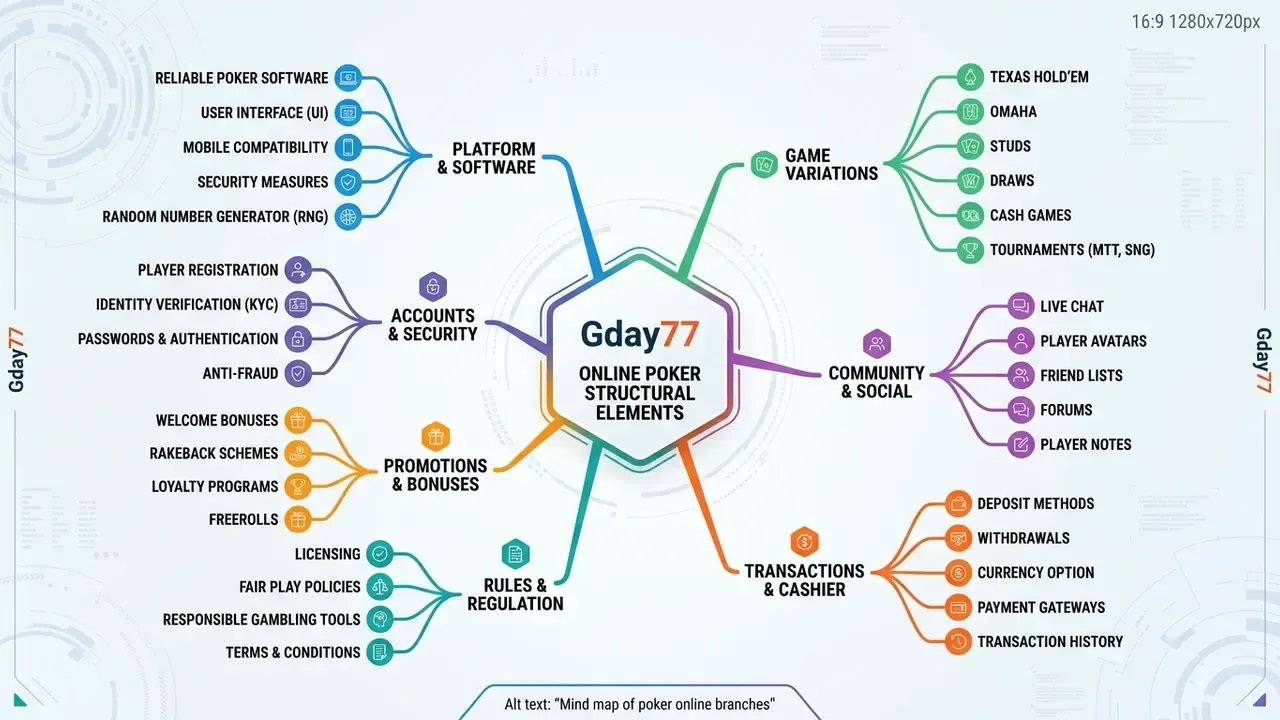
Core branches: poker rules, poker demo, poker real money, poker live dealer, poker strategy, poker games

Online poker, casino poker and live poker formats

Online poker connects individual players to compete against each other in a peer-to-peer format. Casino poker, by contrast, pits a player directly against the house. In a standard online poker setting, the platform acts only as the host, taking a small percentage (rake) from the pot. In casino poker formats, the mathematical house edge is built into the payout rules instead. Live poker options introduce a human dealer through a video stream, blending the convenience of playing online with the tangible presence of physical cards on a real table. Think of it as three distinct experiences sharing the same name.

Online poker, casino poker and live

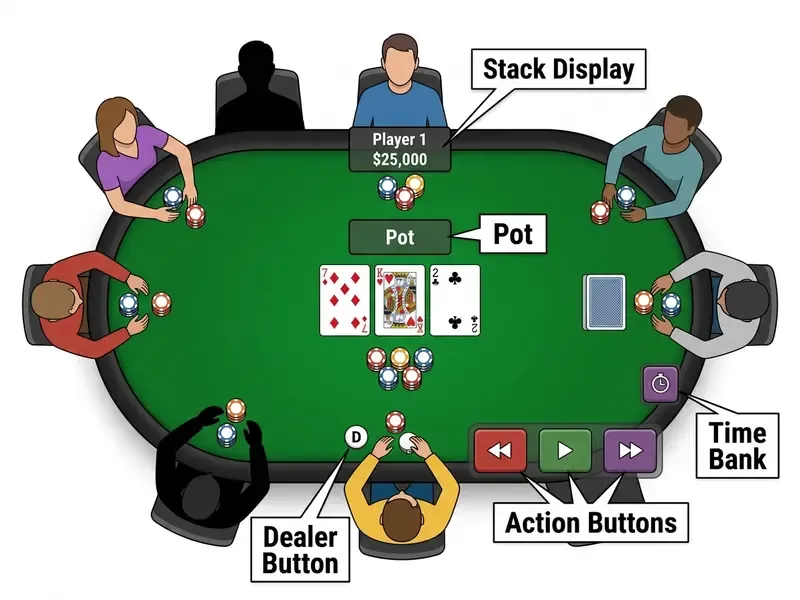
What a player sees at the poker table

The standard online interface displays player stacks, quick-action bet buttons, a time bank, the dealer button position, and the central pot. These elements make up the foundational view for any newcomer joining a table:

  • Stakes / stacks are shown next to each seat, indicating the available chips for every participant.
  • Bet preset buttons speed up action, allowing players to select common sizing (e.g., half pot, three-quarter pot, all-in) rather than typing amounts manually.
  • Time bank acts as a countdown for decisions, keeping the pace consistent. Most platforms grant 15 to 30 seconds per action, with bonus seconds available for difficult spots.
  • Dealer button rotates each hand to determine positional order.
  • Pot sits in the middle of the table, accumulating all active bets.
What a player sees at the

Poker rules beginners need before the first hand

Basic poker rules dictate that participants receive cards, navigate structured betting rounds, and use available actions to compete for the pot. Before looking at advanced strategies, beginners must understand that a hand unfolds chronologically. Players use actions such as calling, raising, or folding to respond to opponents. The ultimate goal is to either hold the highest-ranking combination at the showdown or convince opponents to fold earlier. Knowing the exact sequence and vocabulary helps players transition smoothly from a poker demo into formal environments.

Hand rankings: the complete hierarchy

Every poker hand is ranked according to a strict hierarchy. Below is the full list from strongest to weakest. Memorise it before you sit down:

RankHandDescriptionExample
1Royal FlushA, K, Q, J, 10 of the same suitA♠ K♠ Q♠ J♠ 10♠
2Straight FlushFive consecutive cards of the same suit7♥ 8♥ 9♥ 10♥ J♥
3Four of a KindFour cards of the same rank9♣ 9♦ 9♥ 9♠ K♦
4Full HouseThree of a kind plus a pairQ♠ Q♥ Q♦ 8♣ 8♠
5FlushFive cards of the same suit, not consecutiveA♦ J♦ 8♦ 6♦ 3♦
6StraightFive consecutive cards of mixed suits5♣ 6♦ 7♠ 8♥ 9♣
7Three of a KindThree cards of the same rank7♠ 7♥ 7♦ K♣ 2♠
8Two PairTwo different pairsJ♣ J♠ 4♥ 4♦ A♣
9One PairTwo cards of the same rank10♥ 10♣ A♠ 8♦ 3♣
10High CardNo combination; highest single card playsA♠ J♦ 8♣ 5♥ 2♠

Card values, hand strength and probability

Hand strength is strictly relative. A pair of Aces defeats a pair of Kings, and a standard flush beats a straight. In popular forms like Texas Hold'em, players construct their best five-card hand using two private hole cards combined with five community cards on the board.

Because outcomes rely on probability, knowing the mathematical rarity of these hands is practical. Below are approximate probabilities for a five-card hand drawn from a standard 52-card deck (the classic poker probability baseline):

  • Royal Flush:roughly 0.000154%
  • Straight Flush (excluding royal):roughly 0.00139%
  • Four of a Kind:roughly 0.0240%
  • Full House:roughly 0.1441%
  • Flush:roughly 0.1965%
  • Straight:roughly 0.3925%
  • Three of a Kind:roughly 2.1128%
  • Two Pair:roughly 4.7539%
  • One Pair:roughly 42.2569%
  • High Card:roughly 50.1177%
Gday77 heading-banner

In a seven-card game such as Texas Hold'em (two hole cards plus five community cards), the probabilities shift because more card combinations are available. For example, a royal flush rises to approximately 0.0032%, and a straight to about 4.62%. Players use this scoring knowledge to gauge their relative strength against potential opponent hands. Even a rough grasp of these numbers changes how you approach each street.

Betting rounds, pot and decision options

A standard hand progresses through distinct betting rounds: preflop, flop, turn, and river. Players can choose to bet, call, check, raise, or fold. Every time an action completes, committed chips are moved into the central pot. A wager initiates the action; a call matches it. If no active bet exists, a player may check to pass the action. A fold surrenders the hand.

How the pot builds, a quick example: Player A bets 50 chips on the flop; Player B calls 50. The pot is now 100 plus any pre-flop contributions. On the turn, Player A bets 80; Player B may call (80), raise (to, say, 200), or fold. Each round adds committed chips, so by the river the pot can be many times the initial blind.

When you can raise versus only call: A player may raise whenever it is their turn and the betting structure permits an increase. In a Fixed Limit game, raises are capped at a set number per round (typically three or four). In No Limit, a player may raise any amount up to their stack at any time. If the cap has been reached or action is closed, the only options are to call or fold.

Behavioural data from a 2023 observational study of internet gambling (single global operator) reveals the wide spending spread among real-money players: median total expenditure across two years was €439.70 over a median of 43 sessions, yet the top 1 per cent spent a median of €272,581 over the same period. Understanding and tracking incremental pot commitments, rather than ignoring the cost of seeing another card, is crucial to capital conservation.


Betting rounds, pot and decision options

Betting limits: fixed limit, pot limit and no limit

Betting limits define exactly how much money a player can wager or raise during a given turn:

  • Fixed Limit restricts bets to predetermined increments for each round. The bet and raise sizes are locked by the table structure and do not change within a street.
  • Pot Limit caps any raise so that a player can raise by at most the current pot plus the call amount. In formula terms: Maximum raise = current pot + call amount. After calling, the player may raise up to the newly calculated pot size.
  • No Limit places no maximum restriction. A player may push their entire remaining stack into the centre at any time.

The 2023 skill-dominance data predominantly focused on no-limit structures, as they are the most prevalent on online poker sites and carry the highest variance. The absence of a cap requires a higher degree of emotional discipline. For newer players, starting at low stakes in a fixed limit game can feel less overwhelming while you build confidence.

Betting limits fixed limit, pot limit

Poker Terminology

A shared vocabulary removes confusion at the table. Refer back to this section whenever an unfamiliar term appears.
  • Dealer:The system or individual responsible for shuffling, dealing cards, and tracking bets.
  • Pot:The aggregate accumulation of chips wagered by all active players in a single hand.
  • Blind:Mandatory initial wagers posted by specific positions to stimulate table action.
  • Call:Matching the highest current outstanding bet in the round.
  • Check:Passing the action to the next player without adding chips, available only if no bet exists.
  • Fold:Discarding cards and forfeiting any claim to the active pot.
  • Stake:The specific financial limits of the table or the individual buy-in amount.
  • Bankroll:The total isolated fund a player sets aside exclusively for gambling purposes.
  • Bluffing:Betting with a lower-strength hand to pressure stronger opponent hands into folding.
  • String Bet:A bet or raise made in more than one motion without a verbal declaration. Prohibited in most cardrooms and considered unacceptable conduct.
  • Rakeback:A rebate programme in which a percentage of the rake paid by a player is returned to their account.
  • MTT (Multi-Table Tournament):A tournament format where players start simultaneously across multiple tables and are consolidated as eliminations occur until a final table determines payouts.
Poker Terminology. A shared vocabulary removes

The most popular poker games are distinguished by the number of private cards dealt and whether community cards are shared on a central board. The foundational formats dominate top online poker listings, each presenting a distinct approach to variance and hand-building. Understanding the structural differences is essential before checking current terms on operating sites.

Texas Hold'em, Omaha and Stud

ParameterTexas Hold'emOmaha (PLO)Seven-Card Stud
Hole cards247 (dealt in stages)
Community cards5 (flop / turn / river)5 (same board structure)None
Hand constructionBest 5 from any combination of hole + boardMust use exactly 2 hole + exactly 3 boardBest 5 from own 7 cards
Betting stagesPreflop, Flop, Turn, RiverSame as Hold'emMultiple streets (3rd to 7th street)

In Texas Hold'em, players rely heavily on the five community cards to build a cohesive hand. Omaha demands players use exactly two of their four hole cards alongside three board cards, creating a much higher frequency of premium hands. Seven-Card Stud is played in stages with face-up and face-down cards given strictly to the individual. There is no shared board at all.

No reliable recent public data confirms the exact traffic share split between Texas Hold'em, Omaha, and other limit games. However, observational research on skill dominance predominantly utilises large-scale Texas Hold'em data sets because it remains the benchmark format in the industry. Competitor data from mid-2026 testing indicates that leading offshore platforms maintain 3,000 to 5,000+ concurrent players during peak Australian hours, with the vast majority seated at Hold'em tables.

In Texas Hold'em, players rely heavily

Cash games vs tournaments

Cash games use fixed blinds where chips retain direct monetary value. Tournaments employ scheduled blind escalations and tournament chips with no cash redemption value. A player in a cash game can sit down, play a single sequence, and withdraw their funds entirely at their discretion. In contrast, tournament entries require an initial fee for a locked starting stack. The tournament continues until players are eliminated or a final table determines payout tiers.

Broader data points indicate that regular engagement in gambling with continuous formats requires strict discipline. While multi-table tournaments might cap the initial stake via a fee, the ability to rebuy can quickly compound monetary risk. Something to keep in mind before clicking "re-enter."

Cash games vs tournaments. Cash games

Poker demo vs real money: what to choose first

A poker demo provides a risk-free setting to learn software mechanics, whereas playing poker for real money demands explicit financial risk and emotional control. Demo versions function entirely on virtual credits that hold no monetary value and cannot be withdrawn. Jumping straight into money poker without familiarity with table configurations often leads to unnecessary financial mistakes caused by misclicks or misread rules.

Comparison of poker demo and real money poker across key criteria

CriterionPoker demo (play-money)Poker real money
Financial riskNo real financial loss; chips have no cash value.Real financial risk; losses reduce actual bankroll.
Learning valueEffective for learning rules and software interface.Tests real-world decision-making and risk calculations.
Emotional pressureLower tension; outcomes lack consequence.High intensity; wins and losses provoke strong reactions.
Strategy adaptationGood for testing basics, but opponent play is often random.Critical for refining long-term value against real stakes.
Bankroll requirementsNone needed; entirely virtual funds.Requires strict self-imposed limits and stop-loss tools.

A demo serves as a sandbox. However, the absence of money changes how opponents act, meaning strategic testing remains limited. Real money forces participants to confront actual losses, validating whether their strategy is robust.

When demo mode helps

Demo poker is most beneficial for completely new users looking to understand basic rules, hand hierarchies, and the pace of the software without any financial exposure. Before funding an account, reviewing the layout through free play clarifies where the fold and raise buttons sit. It sounds minor, but misclicking "all-in" when you meant "fold" is a lesson nobody wants to learn with real cash.

The scale of this practice market is substantial. The Australian House of Representatives' 2023-2024 inquiry on simulated gambling noted that social casino environments are popular for recreating the game's flow. In the first half of 2022 alone, Australians spent approximately A$115.8 million on social casino games, the fourth-largest market globally, illustrating how common the demo-to-real pipeline has become.

The simulation, however, limits precise skill development. Because virtual chips carry no real-world consequence, opponents in demo lobbies frequently call large bets with weak cards. This skews the feedback loop: strategies that "work" in free-play may collapse under the discipline of real-money opponents.

When demo mode helps. Demo poker

When real money changes the game

Transitioning to real money fundamentally shifts the psychological landscape by introducing financial risk, variance, and the requirement for disciplined bankroll management. The stakes immediately affect player decisions. A 2023 observational study of internet gambling records revealed that while median spend is often moderate, the real-money context amplifies conditions for chasing losses.

Data from the AGRC National Gambling Trends Study (NGTS) published by the Australian Institute of Family Studies in 2024 reinforces this concern: 87 per cent of 2,565 surveyed regular electronic gaming machine players reported experiencing gambling-related harm, including borrowing money and returning to play in an attempt to recover losses. While poker is structurally different from EGMs, the psychological pattern of loss-chasing transfers directly.

When real money changes the game

According to cross-sectional data from the ANU Gambling in Australia 2024 report, the rate of problem gambling among online players is roughly three times higher than among those who gamble exclusively offline.

The introduction of money means that pre-commitment controls and self-exclusion familiarity are critical tools for safe participation. If you find yourself playing longer sessions than planned or depositing more than your set limit, that is a signal to step back.

How to play poker online step by step

Starting the poker journey involves choosing an appropriate platform, clearing verification protocols, depositing via accepted payment methods, and strictly adhering to self-defined limits. In regulated markets, compliance precedes gameplay. Taking a methodical approach reduces the risk of encountering hidden withdrawal rules or restricted accounts later in the process.

Choosing poker sites and game format

Selecting verified online poker sites requires evaluating jurisdictional legality, transparency of deposit options, and traffic consistency. Regulatory enforcement is active: in Q1 2023, the Australian Communications and Media Authority (ACMA) identified 20 breaches of the IGA and referred 56 websites to internet service providers for blocking. The majority of them offered casino-style games, including poker.

Players must compare platforms based on clear payout history and the availability of responsible gambling tools. Platforms with consistent peak-hour traffic (industry testing in mid-2026 recorded 3,000 to 5,000+ concurrent players on leading sites during Australian evening hours) generally provide a healthier environment where tables fill quickly and game selection remains broad.

Checklist for evaluating a poker site before your first deposit:

  1. Licence and legitimacy: Confirm the operator holds a recognised licence (e.g., Malta Gaming Authority, Curacao, Kahnawake). A licence badge alone is insufficient. Check operator details, complaints history, and whether the RNG has been independently certified.
  2. Payment methods: Look for platforms supporting fast local rails like PayID, e-wallets, or cryptocurrency (BTC, LTC, USDT). Crypto withdrawals at leading sites typically process in under 60 minutes, compared to traditional wire transfers that may take several days.
  3. Traffic and game variety: Filter the lobby during Australian peak hours (17:00 to 20:00 AEST). Multiple active tables at your chosen stakes confirm healthy liquidity.
  4. Responsible gambling tools: Mandatory deposit limits, session timers, self-exclusion options and cooling-off periods should be available.
  5. Customer support responsiveness: Test live chat before depositing. Top-rated platforms respond to queries in under five minutes.

Official regulatory data does not provide a qualitative ranking for offshore sites operating outside of full domestic licensing. The assessment should be grounded in reviewing operator reputation, examining complaints regarding restricted withdrawals, and ensuring the brand supports transparent play over aggressive promotion.

Choosing poker sites and game format

From account setup to the first hand

Account registration currently mandates complete identity and age verification prior to taking the first hand. Under National Consumer Protection Framework (NCPF) updates impacting the broader wagering sector, players must verify identification immediately upon sign-up, removing the previous grace periods.

An important regulatory change took effect on 11 June 2024: online wagering operators in Australia are now required to refuse credit cards, certain digital wallets, and cryptocurrency deposits under the updated NCPF, with penalties of up to A$247,500 for non-compliance. This means the payment methods available to you depend on the specific platform and its licensing jurisdiction. Always confirm accepted deposit options before registering.

From account setup to the first

Department of Infrastructure, Transport, Regional Development, Communications and the Arts, 2024.

Users set their limits, configure their responsible gambling boundaries, and proceed to the lobby to filter cash game tables or tournaments by minimum buy-in (often calculated in big blinds).

Disclaimer: Online poker may be heavily restricted depending on local jurisdiction. Under the Interactive Gambling Act 2001 (IGA), providing interactive casino games to Australian residents by unlicensed operators is generally prohibited. Players must independently verify local legalities, check age limits, and review specific platform terms. Information here serves educational purposes and should not be construed as legal advice or encouragement to gamble. Legislation on online gambling changes frequently. Verify the current status of any platform in your jurisdiction before playing.

Poker live dealer and live casino: what makes them different

Poker live dealer formats substitute automated software distribution with a real human dealer broadcasted via a real-time studio stream. While standard online poker uses an RNG core to distribute digital cards almost instantly, live casino games feature a croupier physically drawing from a shoe. Optical Character Recognition (OCR) technology scans each card as it is dealt, converting the physical result into digital data for instant display on the player's screen. This structural difference fundamentally changes the atmosphere, mirroring a land-based casino while still taking wagers through a digital overlay.

Because the house controls the deal, live dealer poker is always a player-versus-casino format, not peer-to-peer. Variants such as Casino Hold'em, Three Card Poker, and Caribbean Stud are typical. The player bets against the dealer's qualifying hand, and the house edge is built into the payout table rather than extracted as rake. It feels social, but the maths is different.

Poker live dealer and live casino

Live dealer experience vs standard online tables

A live dealer table runs at a significantly slower pace, emphasising social atmosphere over the sheer volume of hands associated with standard RNG lobbies. In software-led spaces, experienced multi-tablers regularly execute 60 to 100+ hands per hour per table, particularly in fast-fold variants like Zone Poker. This figure is widely cited by platforms and consistent with observed play in mid-2026 testing at leading offshore rooms. Live streams, by contrast, are governed by physical dealing speed and scheduled decision windows, typically producing 30 to 40 hands per hour at most.

Players who prefer a measured game often check live dealer options to avoid the rapid speed that sometimes accelerates bankroll depletion.

Live table etiquette for beginners transitioning from online:

When moving from software tables to a live dealer or land-based environment, basic etiquette makes the experience smoother for everyone:

Live dealer experience vs standard online
  • Do not string bet:Announce your action ("raise") clearly and place chips in one motion. Placing bets in multiple delayed movements is called a string bet and is prohibited.
  • Protect your hole cards:Keep your cards on the table and use a chip or card protector. If the dealer accidentally mucks an unprotected hand, you have no recourse.
  • Maintain pace of play:Follow the action, know when it is your turn, and act within a reasonable time. Consistently slow play frustrates the table.
  • If you are not in the hand, keep quiet:Do not comment on the board or other players' likely holdings while a hand is in progress.
Gday77 heading-banner

These etiquette standards are adapted from The Star's published Poker Code of Conduct, which reflects common rules across Australian and international cardrooms.

Poker strategy basics that improve decision-making

Basic poker strategy works by exploiting positional advantages, calculating mathematical pot odds, and rigorously maintaining bankroll limits to endure statistical variance. Good decision-making relies on long-term value. According to the 2023 skill-dominance data, a participant often needs substantial deliberate practice (the study suggested around seven months) to neutralise the inherent mathematical variance of the cards.

Position, starting hands and table awareness

Position determines order of action, meaning late-acting players gather crucial information before deciding to enter the pot with their starting hands. Sitting near the dealer button grants the right to act last on most streets. This allows a player to observe the bet sizes of opponents before committing chips.

Positional example: A hand like J♠ 10♠ might be a profitable open from the Button (late position, strong information advantage) but a clear fold from Under-the-Gun (first to act, no information). Playing fewer hands from early positions and widening the range on the Button is a foundational principle endorsed across training platforms.

Combining this table awareness with a disciplined selection of strong initial cards reduces exposure to marginal, negative-expected-value situations. Over time, making fewer weak calls from poor positions protects the overall stack. It is one of those things that sounds simple but takes real discipline to execute consistently.

Position, starting hands and table awareness

Value betting, bluffing and pot odds

Value betting extracts profit when possessing a statistically strong hand, while bluffing relies heavily on generating a fold mathematically, evaluated against pot odds.

Core concepts:

  • Pot odds compare the current size of the money in the centre to the actual cost of a call. If the cost matches the mathematical probability of completing a winning hand, calling is justified.
  • Equity is the percentage share of the pot you are mathematically entitled to, based on your likelihood of winning at showdown.
  • Expected Value (EV) is the average net result of a decision over many repetitions.

If the cost of a call is justified by the pot odds and your equity, calling is profitable. Conversely, when equity is low, bluffing depends strictly on fold equity, the likelihood that opponents will fold to your bet. A bluff is profitable when the fold frequency multiplied by the pot exceeds the cost of the bet multiplied by the frequency of being called.

Value betting, bluffing and pot odds

A 2024 psychometric and EEG study of regular online poker players found that they tend to exhibit higher physical anhedonia and elevated BAS-Drive, a motivational tendency towards goal pursuit, which may influence risk-taking behaviour at the table. Recognising these tendencies is the first step to managing them.

Bankroll and stake control for longer play

Maintaining an isolated bankroll and playing strictly at low limits relative to that fund is the primary defence against the natural volatility of poker. Without sufficient buy-ins, regular variance can deplete funds rapidly regardless of skill. Conservative bankroll management guidelines widely recommended by poker training schools suggest holding at least 20 to 30 buy-ins for cash games (e.g., if playing NL2 with a $2 max buy-in, a bankroll of $40 to $60) and 100+ buy-ins for MTTs, where variance is significantly higher.

"One relatively simple harm-reduction measure is preventing people from using money they don't have." - Australian Institute of Family Studies (AIFS), 2024.

This principle is now being embedded in legislation. In Tasmania, a mandatory card-based system is being introduced with default loss limits of A$100 per day, A$500 per month, and A$5,000 per year. Players must demonstrate financial capacity before accessing higher thresholds. While this reform targets EGMs, the philosophy maps directly onto poker bankroll discipline.

Players should avoid moving to higher stakes prematurely to recover losses. Treat stake control as the defining characteristic of a professional approach. Playing within the limits of a dedicated gambling fund, separate from household finances, is the single most impactful responsible-play measure available. It is not glamorous advice, but it works.

This principle is now being embedded

How to choose the best poker option for your goal

The best online poker format is determined by whether the user seeks risk-free learning, casual entertainment, or highly disciplined cash play. Different goals necessitate completely different structural approaches, balancing the time commitment required against the intrinsic variance of the format.

Formats of poker matched against specific user goals

Player GoalSuitable Poker FormatWho It Suits
Learning the layout without riskPoker demo / Play-money gamesBeginners establishing baseline knowledge of rules and interface.
Casual, slow-paced atmospherePoker live dealer / Live casinoUsers seeking physical casino vibes without software speed.
Continuous session accessLow-stakes cash gamesParticipants wanting to control entry and exit timing freely.
Fixed financial exposureTournaments (MTTs)Players comfortable trading long session times for a capped buy-in.

According to cross-sectional data, the rate of problem gambling among online players is approximately three times higher than among those who gamble exclusively offline. - ANU Gambling in Australia 2024 / AGRC comparative data.

Check the limits of a given platform, ensuring it offers low stakes and visible hand-history logs prior to proceeding. If a site does not let you review your own hand history, consider that a red flag.

FAQ about poker online, demo and real money play

What is the difference between online poker and casino poker?

Legally and logically, standard online poker is a PVP (player versus player) setup where you play against others, and the site takes a rake. Casino poker is house-banked, meaning you play directly against the dealer's hand with fixed house-edge payouts. The distinction matters because your edge in PVP poker comes from outplaying opponents, while in casino poker the house edge is baked into the payout structure.

Is playing a poker demo enough before depositing real money?

Demo modes acquaint a user with rules and button placements, but no official benchmark outlines a fixed "hours required" threshold. Simulations lack the emotional weight and realistic opponent behaviour seen when actual bankrolls are at risk. A practical approach: play demo until you can identify all hand rankings from memory and navigate betting rounds without hesitation, then transition to the lowest available real-money stakes.

Does a live dealer environment suit absolute beginners?

While visually appealing, the environment mimics live casino pressure. Beginners may fare better at low-stake standard tables where action flow is transparent and they can consult rules without holding up a live feed. Once you are comfortable with the basics, live dealer tables offer a more social experience.

How do buy-ins and limits function after joining sites?

Once registered on poker sites, users select limits in the room lobby. Tables specify minimum and maximum buy-ins, keeping stakes uniform. Re-buys are entirely subject to the specific format's terms: they are usually allowed in cash games between hands but are strictly timed in tournaments. Always compare withdrawal conditions before initiating your first deposit.

What payment methods do Australian-facing poker sites accept?

The most commonly available options include cryptocurrency (BTC, LTC, USDT), e-wallets, and in some cases PayID. Following the June 2024 NCPF reform, credit cards are banned for online wagering with licensed Australian operators. Crypto withdrawals at leading sites typically process within 60 minutes, while bank transfers can take several days.

How do I know if a poker site is safe?

Start by confirming the operator's licence, verifying independent RNG certification, and testing customer support response times before depositing. Check community forums for withdrawal complaint patterns. If an operator is listed on the ACMA's blocked-site register, avoid it entirely. Trust is built on transparency, not promises.